

Why a GLP-1 needs a different food log
The labels describe these medicines as reducing calorie intake by affecting appetite.23 That changes the job of a food log. The risk is less "too much" and more "not enough protein, fibre or fluid" — especially on the days after a dose, when appetite is lowest. The 2025 joint advisory from four US nutrition and obesity-medicine organisations puts nutrient-dense, minimally processed food and adequate protein at the top of its priorities, and flags the risk of nutrient shortfalls at very low intakes.1
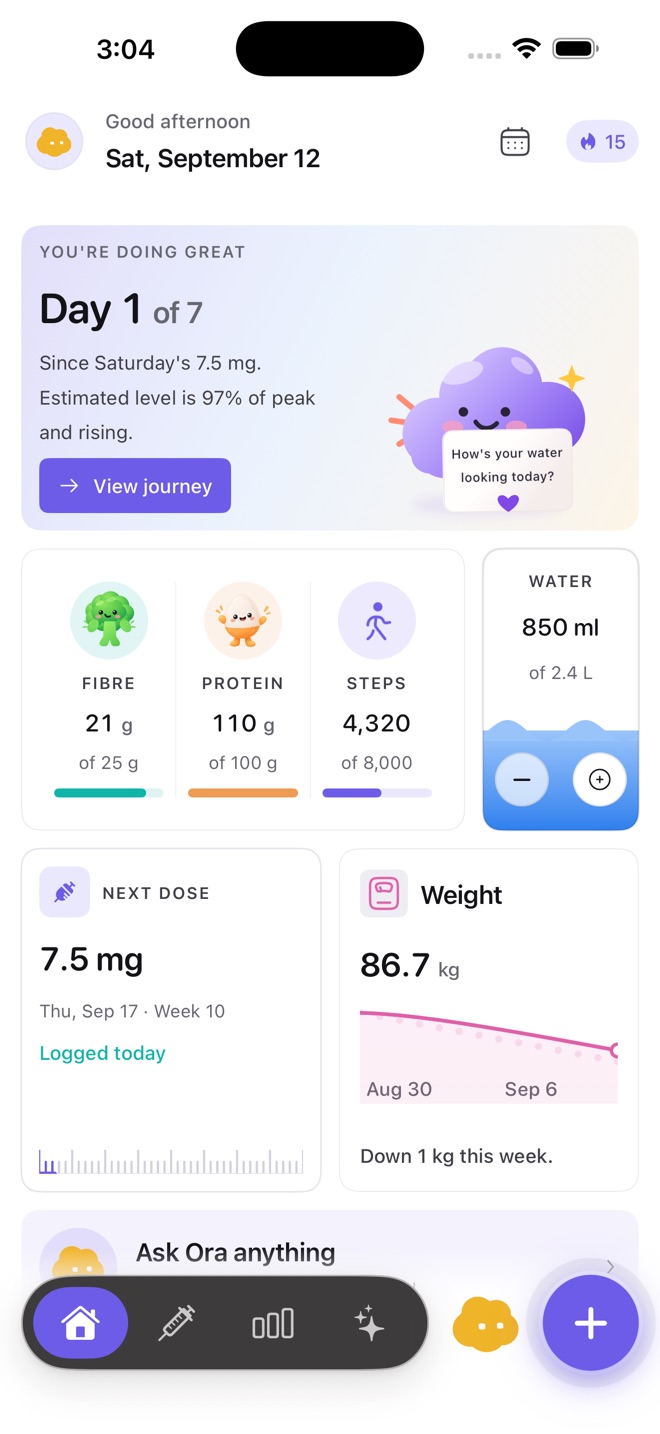
So Cafeity's log leads with protein, fibre and water; shows calories as context rather than a budget; never colours a food red; and never sets an energy target below 1,200 kcal.
Four ways to log
- Photo — take a picture of the plate and the app estimates what is on it. The AI photo logging has a free allowance; unlimited use is part of Cafeity Pro.
- Search — a food database built on USDA FoodData Central and Open Food Facts.4
- Barcode — scan packaged food.
- Quick-add — just the protein or calories, for the days when detail is too much.
On a day when eating is hard, a rough log beats no log. A single tap for "protein shake" is worth more than a perfect record you gave up on in week two.
Food on the same timeline as the dose
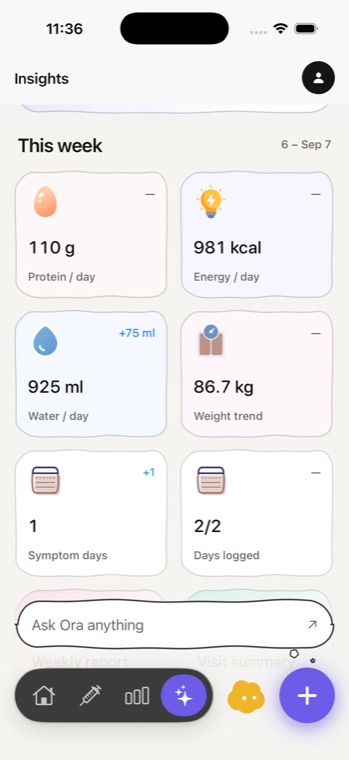
The reason to keep food in the same app as the medicine is the chain between them: dose, then appetite and side effects, then what you could eat, then how you felt. Ora can describe that chain from your own entries — "your protein was below target on four of the last seven days, the three lowest all within 48 hours of an injection" is the kind of sentence it writes — and every number in it traces back to something you logged.
See what to eat on injection day and eating with no appetite.
Targets, and where they come from
Cafeity derives its reference figures in the open: protein at 1.4 g per kg of body weight, water at 33 ml per kg, and fibre at 25 g (30 g for men) — each with its working shown on the calculators. They are context for your own discussion with a prescriber or dietitian, not instructions, and you can set your own targets in Cafeity Pro.
Where your data lives
On your device and in your own account, under per-record permissions. Health data is never stored in iCloud, never sold, never used for advertising, and never used as training data. You can export everything in one file, and you can delete the record entirely. The Visit Summary builds a one-page PDF only when you ask it to, and nothing leaves the phone until you share it yourself.
What Cafeity will never do
- Recommend, calculate or adjust a dose, or tell you when to take one.
- Interpret a symptom, name a condition, or suggest what is causing something.
- Predict how much weight you will lose, or when.
- Set a calorie target below 1,200 kcal, or a weight goal below a BMI of 18.5.
Cafeity is a general wellness product. It does not diagnose, treat, cure, mitigate or prevent any disease or condition. Questions about your treatment belong with a licensed healthcare professional.
Keeping a record of it
Screens from Cafeity on iPhone.
Common questions
Does Cafeity count calories?
Is photo food logging free?
Can I import food from another app?
Sources
- Nutritional priorities to support GLP-1 therapy for obesity: a joint advisory from the American College of Lifestyle Medicine, the American Society for Nutrition, the Obesity Medicine Association and The Obesity Society Mozaffarian D et al. 2025 (published in four journals)
- Semaglutide injection and tablets for weight management — US prescribing information DailyMed, US National Library of Medicine, version published 30 June 2026
- Tirzepatide injection for weight management and obstructive sleep apnoea — US prescribing information DailyMed, US National Library of Medicine, version published 2 September 2026
- FoodData Central US Department of Agriculture, Agricultural Research Service
Written by the Cafeity team from the sources listed here. Figures from prescribing information are quoted as the label states them; trial results are averages from those trials, not predictions for any one person. This page has not yet been reviewed by a clinician — see the editorial policy for how pages are researched and corrected.