

At a glance
| Value | |
|---|---|
| Administration | Usually a once-weekly injection. An oral daily formulation also exists; Cafeity records either, because it records what you tell it. |
| Published half-life | about 7 days (roughly 165 hours) — One of the longest half-lives in the class, which is what makes weekly dosing practical. |
| Dosing interval modelled | 7 days |
| Used in Cafeity for | The decay constant behind the Cycle View, and nothing else. |
Half-life figures are published population averages, used only as the decay constant in Cafeity's schedule model. They are not your pharmacokinetics, and nothing on this page is dosing information.
What semaglutide is, in one paragraph
Semaglutide is a GLP-1 receptor agonist — a peptide that mimics a hormone the gut releases after eating. That is the extent of the description you will find on this site. Cafeity is a record-keeping tool, not a drug reference, so anything that belongs on a label — what it is approved for, who should not take it, what to watch for, how it interacts with other medicines — is linked to an authoritative source at the foot of this page rather than restated here by people who are not your clinicians.
What this page does cover in depth is the part Cafeity is genuinely responsible for: how a long half-life shapes a week, what the app records, and exactly how the number on the chart is worked out.
What a long half-life changes about tracking
With a half-life close to the dosing interval, semaglutide accumulates. The second dose lands while most of the first is still there, the third lands on top of that, and the record only starts describing a typical week once that build-up settles — a matter of weeks, not days. A tracker that treats week one and week six as equivalent is quietly comparing two different situations.
It also means the days within a week are not interchangeable. Two identical meals, two identical rough afternoons, can sit at very different points on the modelled curve. Recording where in the cycle something happened is most of what makes the record worth bringing to an appointment, and it is the single thing a general food-logging app cannot do.
How the Cycle View is worked out
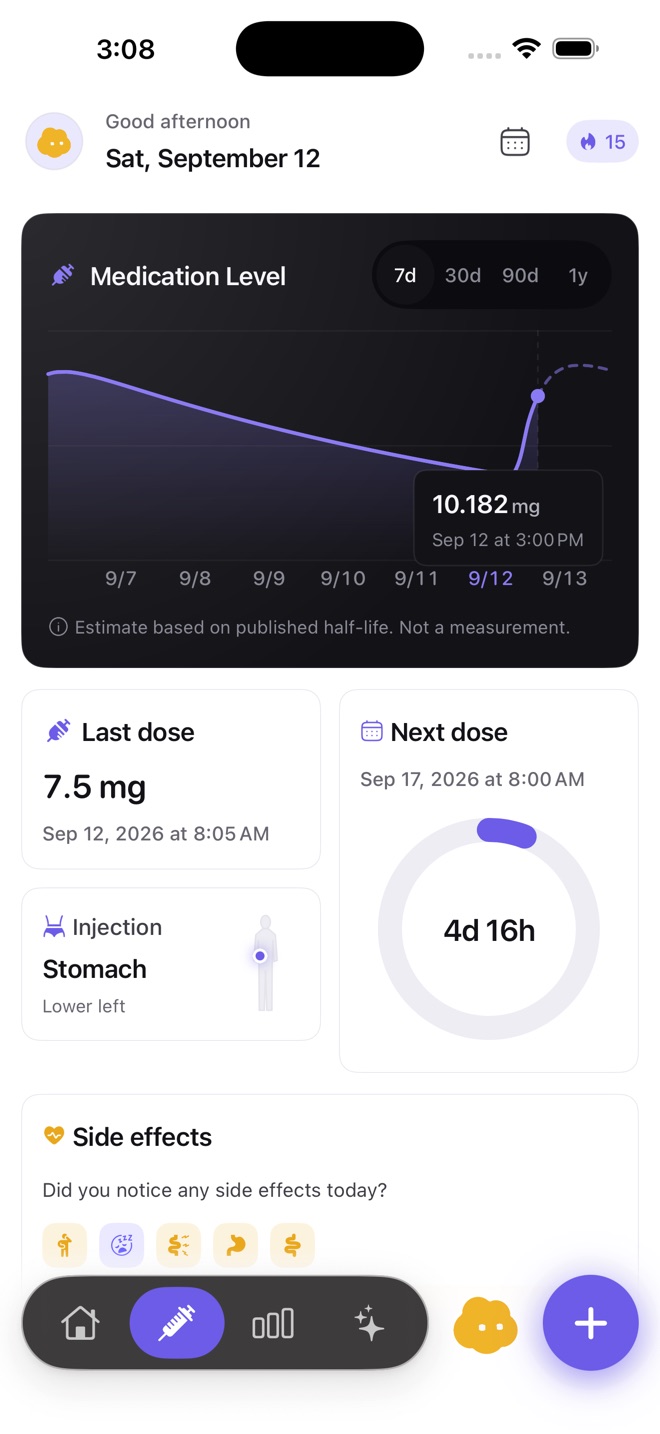
The Cycle View is a schedule model, not a measurement. It takes the dose dates you logged, assumes each dose decays exponentially with the published half-life above, and adds them together. In full: level(t) = Σ 0.5 ^ ((t − tdose) / half-life), with one unit added per dose.
That is the entire mechanism. It knows nothing about your blood, your metabolism, your kidney function or the actual amount you were prescribed — which is why the y-axis below is unitless and relative to a single dose. The shape is the only part that means anything.

Accumulation and steady state
Because a dose arrives before the previous one has cleared, the modelled level builds for the first few weeks and then repeats. These figures fall straight out of the half-life — you can check every one of them on the half-life calculator.
| Value | Where it comes from | |
|---|---|---|
| Remaining when the next dose is due | 49% | 0.5 ^ (7 days ÷ 6.9 days) |
| Peak once settled | 1.98× a single dose | 1 ÷ (1 − remaining fraction) |
| Time to reach roughly 97% | about 34 days | five half-lives |
In other words, the first 5 weeks or so are not a typical week — the record is still describing a rising baseline. That is worth knowing before comparing week one with week ten.
What the record holds
Every entry below sits on one timeline, so any of them can be read against where you were in the medication cycle when it happened.
- Doses — date, time, the amount you were prescribed, and the medication as a plain label.
- Injection site, on a body map, so rotation is visible rather than remembered.
- Meals, with protein, fibre and hydration derived from what you logged.
- Symptoms, in your words, with your own severity rating.
- Weight and measurements, shown as a trend rather than a daily verdict.
Inside the app
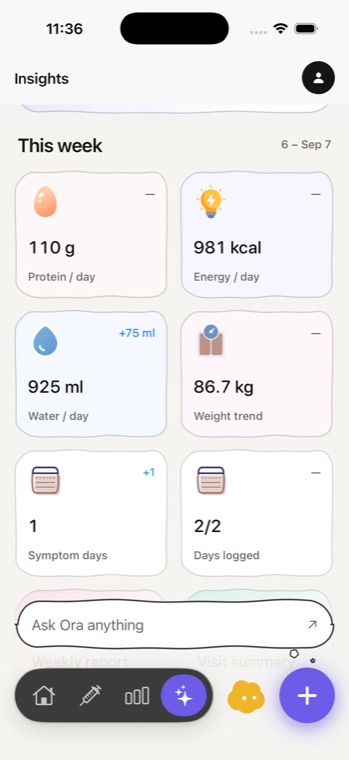
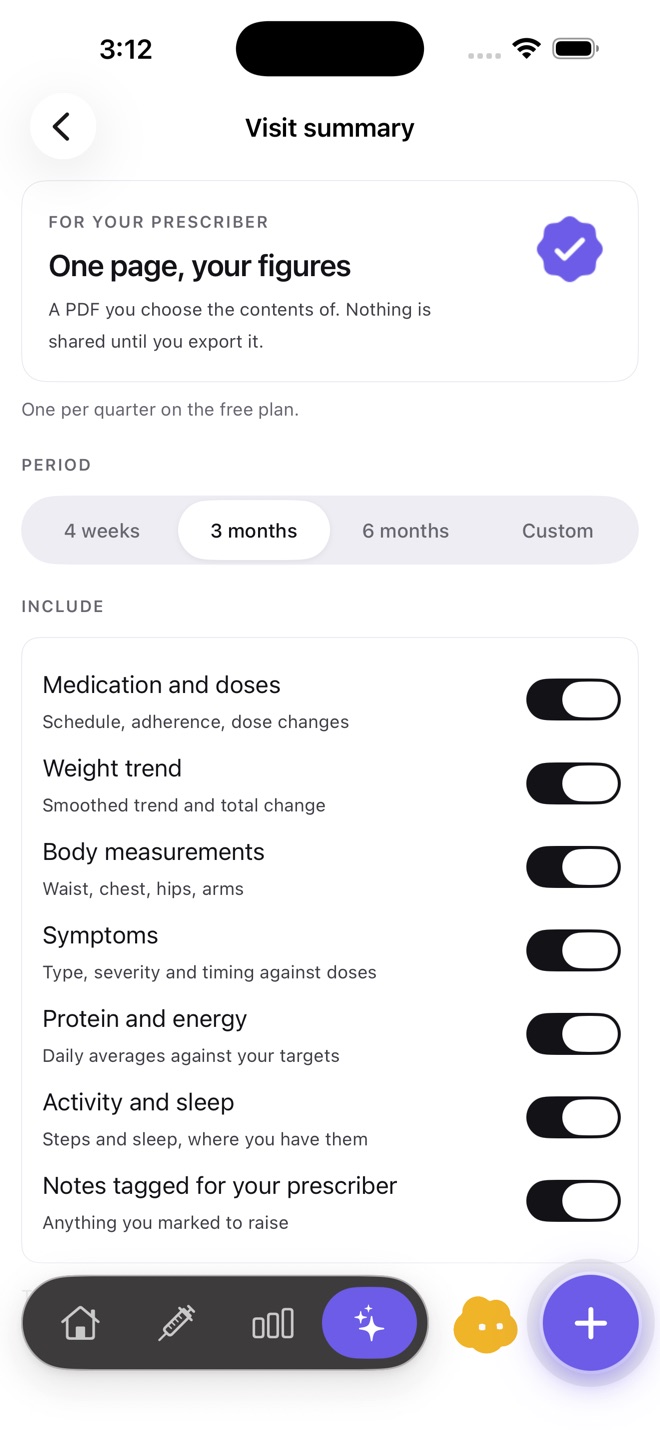
Screenshots from Cafeity on iPhone. The app is on the App Store; screens change as it is updated.
Beyond the dose record
The dose is the anchor, but it is not the whole record. Each of these has its own page.
- Protein comes first — appetite usually falls and total intake falls with it, so the figure worth watching is protein rather than calories. Cafeity derives a daily figure from body weight and shows the gap, without instructing you to change anything.
- Symptoms are recorded, not diagnosed — you log what you felt and how strongly; the app places it on the timeline and stops there.
- Weight is a trend, not a verdict — and never a prediction.
- Sites live on the dose record, so rotation is a glance rather than a guess.
Where your data lives
On your device and in your own account, under per-record permissions. Health data is never stored in iCloud, never sold, never used for advertising, and never used as training data.
You can export everything in one file at any time, and you can delete the record entirely. When you want to bring something to an appointment, the Visit Summary builds a one-page, print-ready PDF from a period and the sections you choose — and nothing leaves the phone until you do that yourself.
What Cafeity will never do
- Recommend, calculate or adjust a dose, or tell you when to take one.
- Interpret a symptom, name a condition, or suggest what is causing something.
- Predict how much weight you will lose, or when.
- Set a calorie target below 1,200 kcal, or a weight goal below a BMI of 18.5.
Cafeity is a general wellness product. It does not diagnose, treat, cure, mitigate or prevent any disease or condition. Questions about your treatment belong with a licensed healthcare professional.
Common questions
Does Cafeity tell me when to take my next dose?
Is the estimated level in the Cycle View my actual blood concentration?
Does it work with compounded semaglutide?
Can I bring this to my prescriber?
Does the oral form work the same way in the app?
Further reading
Cafeity is a record-keeping tool, not a drug reference. Anything clinical — what a medication is approved for, who should not take it, what to watch for, how it interacts with other medicines — belongs with the sources below and with your own prescriber.
- Semaglutide NHS
- Semaglutide Injection MedlinePlus
- Medicines A to Z NHS
- Drugs, Herbs and Supplements MedlinePlus, US National Library of Medicine
- DailyMed — FDA prescribing information US National Library of Medicine
External links open in a new tab. Cafeity is not affiliated with any of these organisations.