
Recording is the whole feature
You log the symptom, the date and your own severity rating. It appears on the timeline beside your doses, meals and hydration. Cafeity does not tell you what it means, does not attribute it to the medication, and does not sort anything into normal or worrying.
That boundary is the product, not a caveat bolted on to it. An app that grades symptoms is making a clinical judgement, and it is making it without an examination, a history, or any knowledge of the rest of your medicine cabinet. Cafeity declines to do it because it is not in a position to do it well.
Why the timeline matters more than the list
A list of symptoms loses the thing that makes them legible: when they happened relative to a dose, a change in amount, a bad night's sleep, or a day of very little food. Putting them on one axis is what makes the record worth bringing to an appointment.
It also makes your own observations checkable. A pattern you half-remember — that it is always the two days after — is either in the record or it is not, and finding out which is more useful than either believing it or dismissing it.
Gentle mode
Some days are not the day for a form with eleven fields. Gentle mode reduces logging to the minimum so the record survives a rough week instead of breaking on it.
This matters more than it sounds. The weeks people stop logging are disproportionately the weeks worth having logged, so the design goal is a record that degrades gracefully rather than one that demands completeness.
When to stop logging and call someone
If something feels severe, sudden or frightening, that is a call to a clinician or emergency services — not an entry in an app. Cafeity has no triage, no urgency scoring, and no ability to tell you whether something is serious.
Nothing on this page, and nothing in the app, should be used to decide whether a symptom needs attention. The sources at the foot of this page describe what the labels say; your prescriber knows your circumstances, and this app knows neither.
What the record holds
Every entry below sits on one timeline, so any of them can be read against where you were in the medication cycle when it happened.
- Doses — date, time, the amount you were prescribed, and the medication as a plain label.
- Injection site, on a body map, so rotation is visible rather than remembered.
- Meals, with protein, fibre and hydration derived from what you logged.
- Symptoms, in your words, with your own severity rating.
- Weight and measurements, shown as a trend rather than a daily verdict.
Inside the app
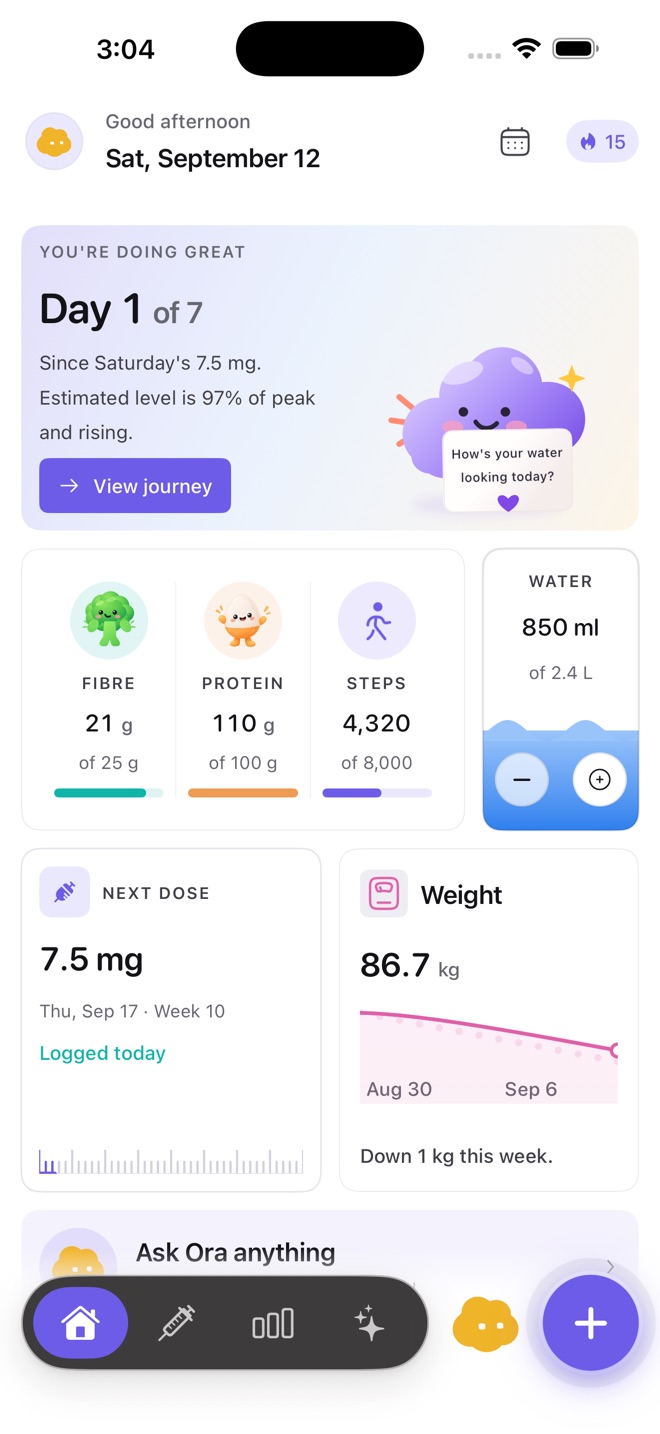
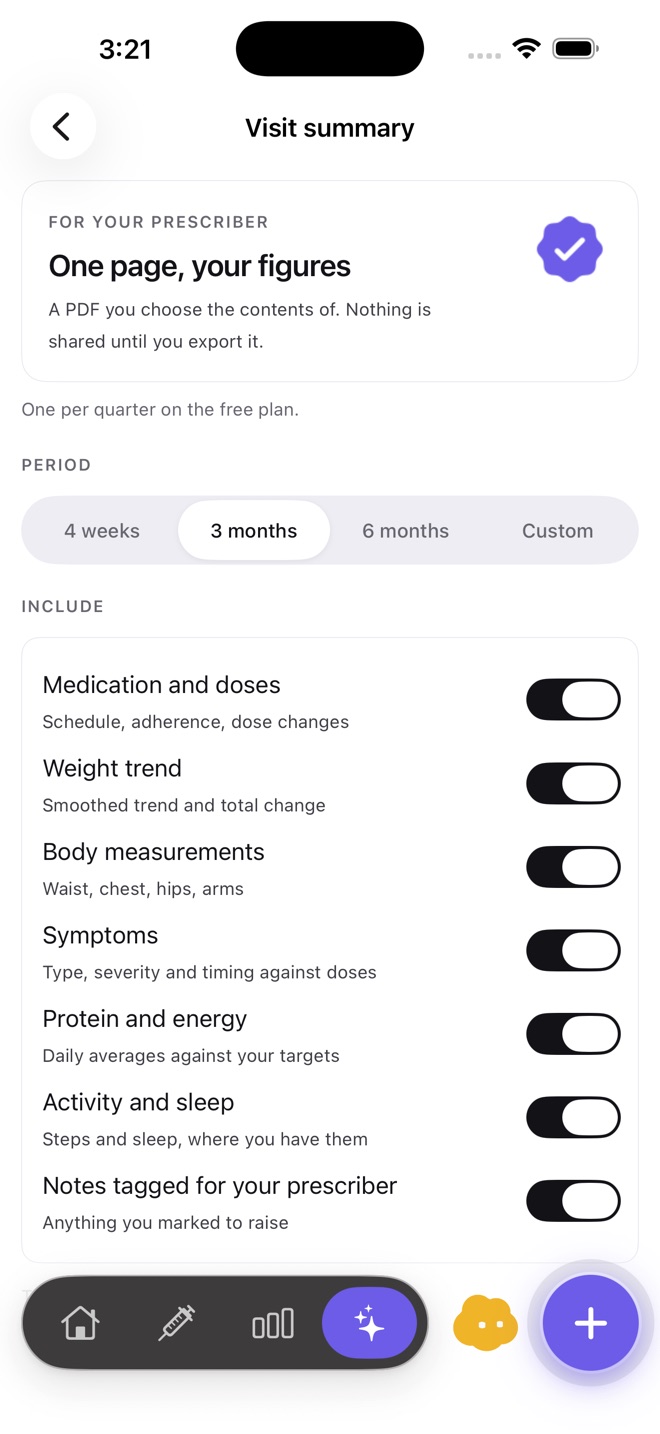
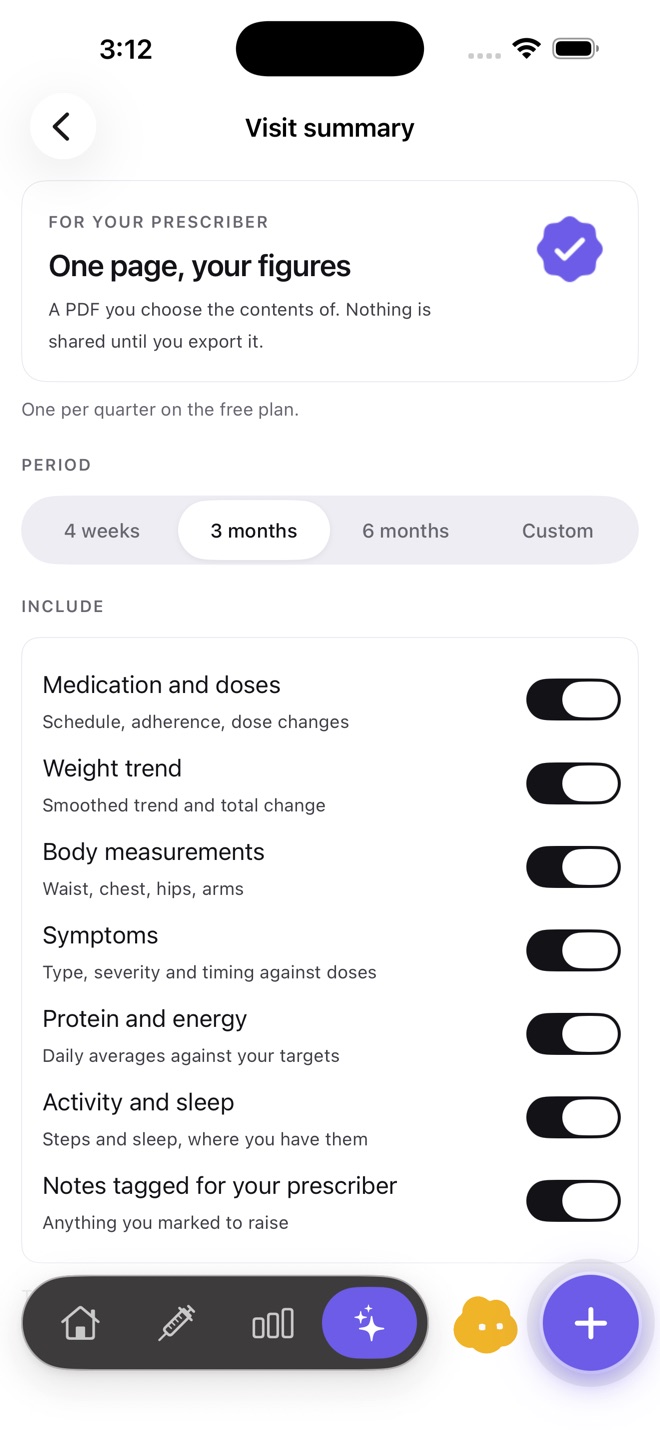
Screenshots from Cafeity on iPhone. The app is on the App Store; screens change as it is updated.
Across every medication
This works the same way whichever medication you are on — the only thing that changes is the half-life behind the curve.
- Semaglutide — once weekly, published half-life about 7 days (roughly 165 hours).
- Tirzepatide — once weekly, published half-life about 5 days (roughly 117 hours).
- Liraglutide — once daily, published half-life about 13 hours.
- Dulaglutide — once weekly, published half-life about 4.7 days (roughly 112 hours).
- Exenatide — twice daily, or weekly in the extended-release form, published half-life about 2.4 hours for the immediate-release form.
Where your data lives
On your device and in your own account, under per-record permissions. Health data is never stored in iCloud, never sold, never used for advertising, and never used as training data.
You can export everything in one file at any time, and you can delete the record entirely. When you want to bring something to an appointment, the Visit Summary builds a one-page, print-ready PDF from a period and the sections you choose — and nothing leaves the phone until you do that yourself.
What Cafeity will never do
- Recommend, calculate or adjust a dose, or tell you when to take one.
- Interpret a symptom, name a condition, or suggest what is causing something.
- Predict how much weight you will lose, or when.
- Set a calorie target below 1,200 kcal, or a weight goal below a BMI of 18.5.
Cafeity is a general wellness product. It does not diagnose, treat, cure, mitigate or prevent any disease or condition. Questions about your treatment belong with a licensed healthcare professional.
Common questions
Will the app tell me if a symptom is normal?
Can I show a doctor what I logged?
Does Ora comment on my symptoms?
Is symptom data shared with anyone?
Further reading
Cafeity is a record-keeping tool, not a drug reference. Anything clinical — what a medication is approved for, who should not take it, what to watch for, how it interacts with other medicines — belongs with the sources below and with your own prescriber.
- Medicines A to Z NHS
- Drugs, Herbs and Supplements MedlinePlus, US National Library of Medicine
- DailyMed — FDA prescribing information US National Library of Medicine
External links open in a new tab. Cafeity is not affiliated with any of these organisations.