
What a dose record holds
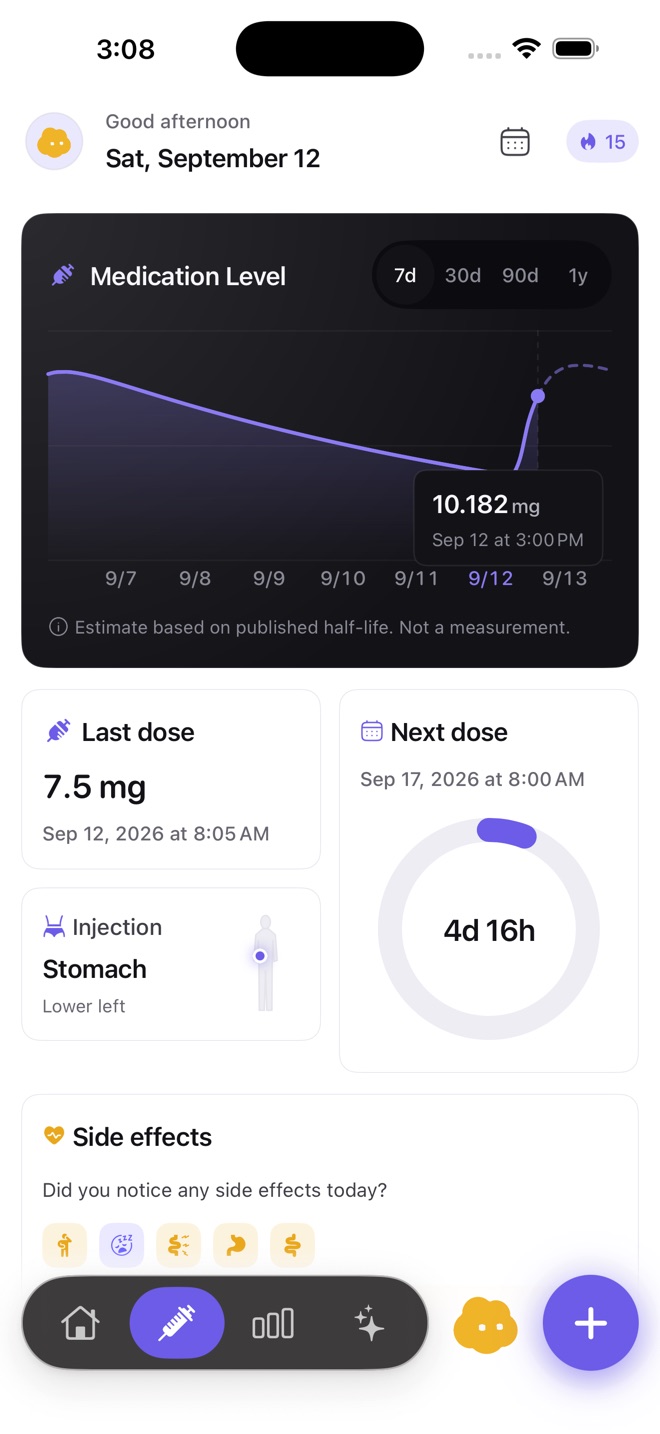
The date and time, the amount you were prescribed, the medication as a plain label, and the injection site. That is deliberately close to what a prescriber would ask, so the record answers the question rather than needing translation at the appointment.
It is also deliberately dumb. There is no field for how you think the dose went, no score, no streak. A dose record is a fact about what happened, and the moment an app starts grading it, the record stops being neutral.
The cycle, not the calendar
Most trackers organise by day. On a weekly medication, the more useful axis is position in the cycle, which is why the Cycle View draws an estimated level from your logged dose dates and the published half-life for that molecule. The half-life is the only thing that differs between medications; the model is identical.
The comparison chart on the trackers index shows how much that one number changes the picture — a single dose of liraglutide is essentially gone in three days, while a single dose of semaglutide is still around half-present after a week.

Reminders you set, never suggestions we make
You can set a reminder for a schedule you were given. Cafeity will never propose a schedule, suggest moving a dose, or comment on an amount. There is no code path in the app that does any of those things — it is a structural property, not a policy that could be relaxed in a later release.
This is the clearest single difference between Cafeity and most of the category, and it is a real cost: dose-timing guidance is a popular feature. The reasoning is set out in full on the comparison pages.
Changes and gaps are part of the record
Titration steps, a late dose, a skipped week — all of it is loggable exactly as it happened. A record that only accepts the ideal version of events is not much use at an appointment, and quietly teaches you to stop logging the weeks that went badly, which are usually the informative ones.
Gentle mode exists for the same reason: on a rough week, logging drops to the minimum rather than breaking entirely.
What the record holds
Every entry below sits on one timeline, so any of them can be read against where you were in the medication cycle when it happened.
- Doses — date, time, the amount you were prescribed, and the medication as a plain label.
- Injection site, on a body map, so rotation is visible rather than remembered.
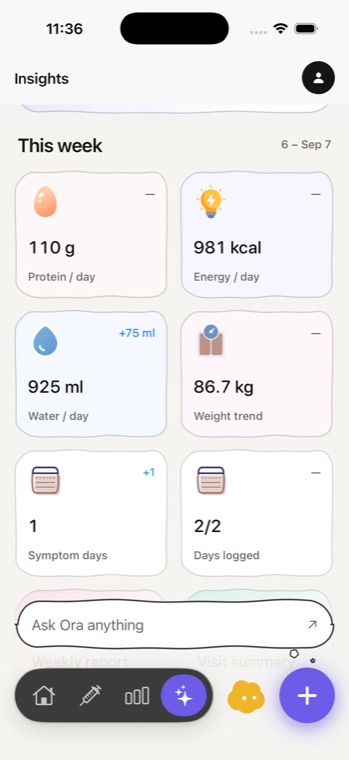
- Meals, with protein, fibre and hydration derived from what you logged.
- Symptoms, in your words, with your own severity rating.
- Weight and measurements, shown as a trend rather than a daily verdict.
Inside the app
Screenshots from Cafeity on iPhone. The app is on the App Store; screens change as it is updated.
Across every medication
This works the same way whichever medication you are on — the only thing that changes is the half-life behind the curve.
- Semaglutide — once weekly, published half-life about 7 days (roughly 165 hours).
- Tirzepatide — once weekly, published half-life about 5 days (roughly 117 hours).
- Liraglutide — once daily, published half-life about 13 hours.
- Dulaglutide — once weekly, published half-life about 4.7 days (roughly 112 hours).
- Exenatide — twice daily, or weekly in the extended-release form, published half-life about 2.4 hours for the immediate-release form.
Where your data lives
On your device and in your own account, under per-record permissions. Health data is never stored in iCloud, never sold, never used for advertising, and never used as training data.
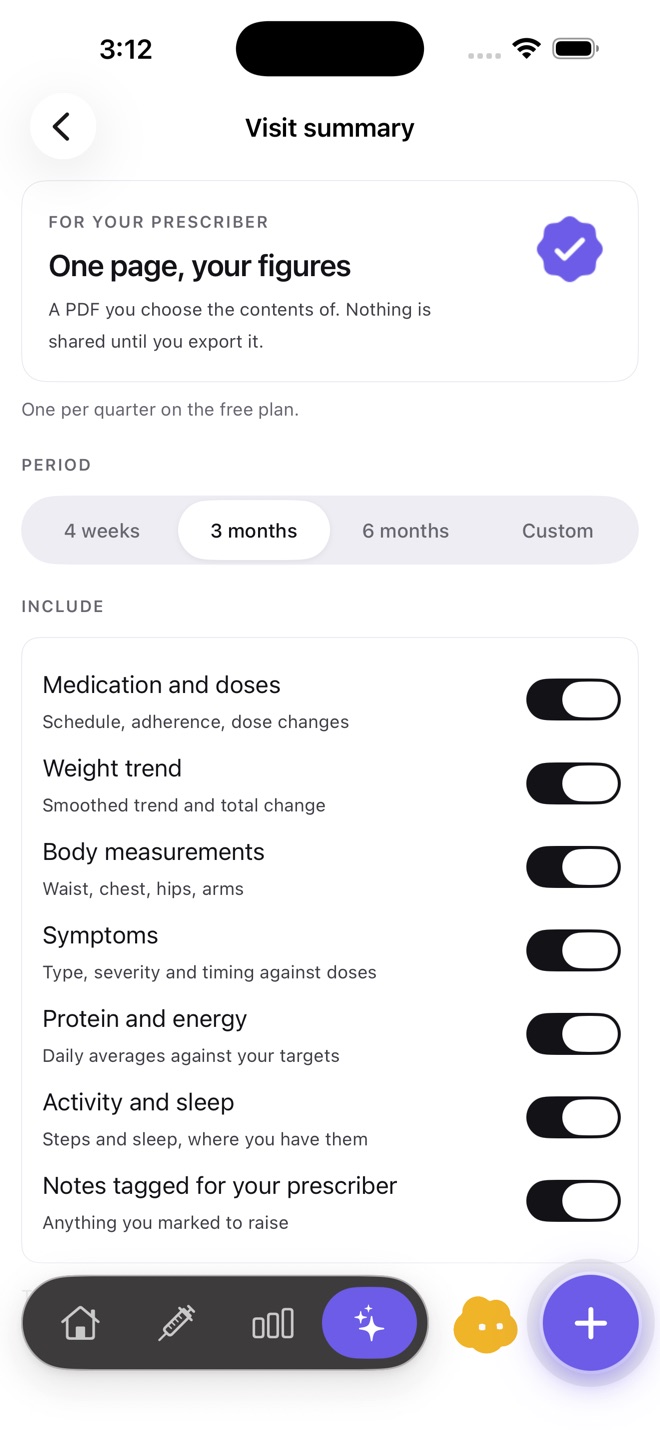
You can export everything in one file at any time, and you can delete the record entirely. When you want to bring something to an appointment, the Visit Summary builds a one-page, print-ready PDF from a period and the sections you choose — and nothing leaves the phone until you do that yourself.
What Cafeity will never do
- Recommend, calculate or adjust a dose, or tell you when to take one.
- Interpret a symptom, name a condition, or suggest what is causing something.
- Predict how much weight you will lose, or when.
- Set a calorie target below 1,200 kcal, or a weight goal below a BMI of 18.5.
Cafeity is a general wellness product. It does not diagnose, treat, cure, mitigate or prevent any disease or condition. Questions about your treatment belong with a licensed healthcare professional.
Common questions
Will it remind me to take my dose?
Does it work with any GLP-1?
Does it work with compounded medication?
Is my dose history stored in iCloud?
Further reading
Cafeity is a record-keeping tool, not a drug reference. Anything clinical — what a medication is approved for, who should not take it, what to watch for, how it interacts with other medicines — belongs with the sources below and with your own prescriber.
- Medicines A to Z NHS
- Drugs, Herbs and Supplements MedlinePlus, US National Library of Medicine
- DailyMed — FDA prescribing information US National Library of Medicine
External links open in a new tab. Cafeity is not affiliated with any of these organisations.