
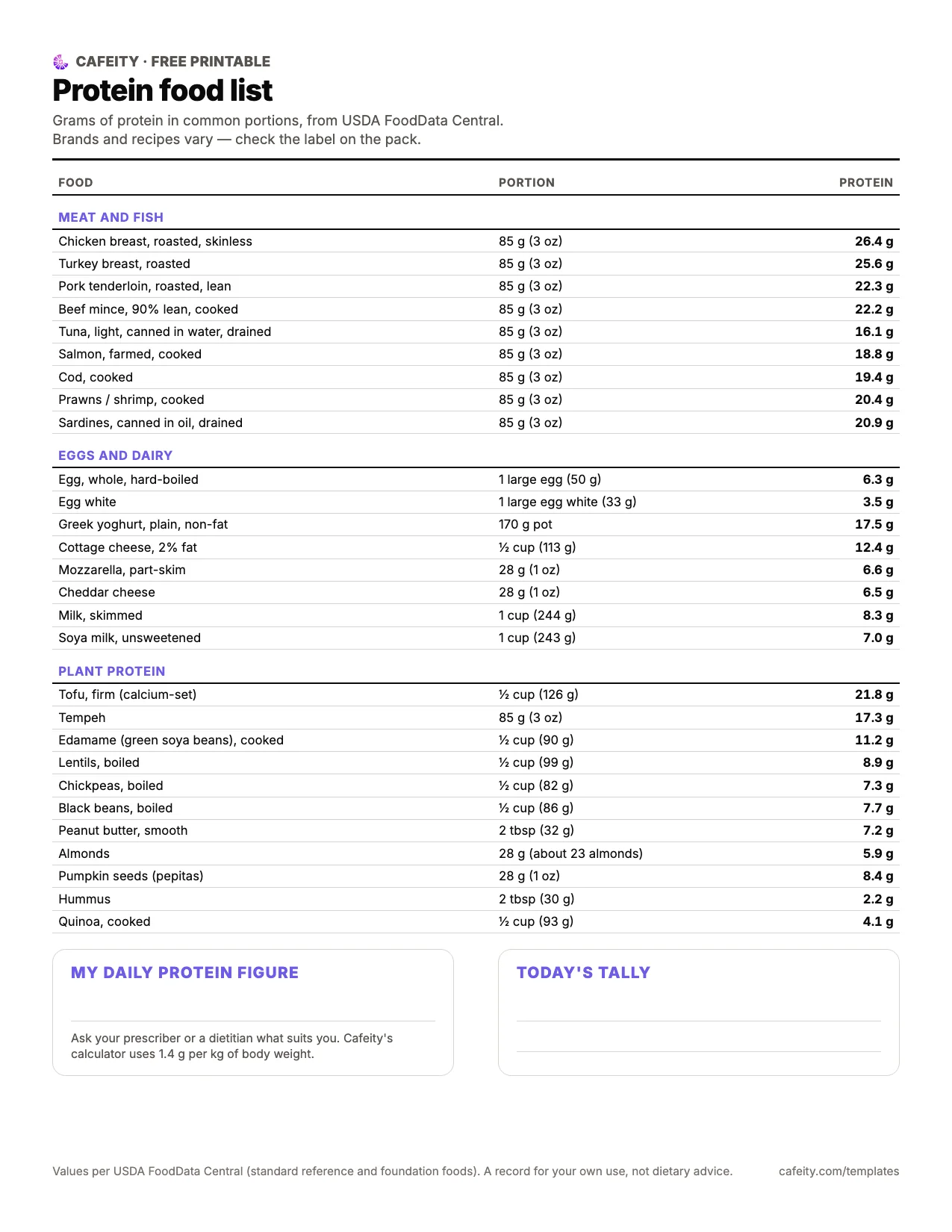

The full list
| Food | Portion | Protein | Per 100 g |
|---|---|---|---|
| Chicken breast, roasted, skinless | 85 g (3 oz) | 26.4 g | 31 g |
| Turkey breast, roasted | 85 g (3 oz) | 25.6 g | 30.1 g |
| Pork tenderloin, roasted, lean | 85 g (3 oz) | 22.3 g | 26.2 g |
| Beef mince, 90% lean, cooked | 85 g (3 oz) | 22.2 g | 26.1 g |
| Tuna, light, canned in water, drained | 85 g (3 oz) | 16.1 g | 19 g |
| Salmon, farmed, cooked | 85 g (3 oz) | 18.8 g | 22.1 g |
| Cod, cooked | 85 g (3 oz) | 19.4 g | 22.8 g |
| Prawns / shrimp, cooked | 85 g (3 oz) | 20.4 g | 24 g |
| Sardines, canned in oil, drained | 85 g (3 oz) | 20.9 g | 24.6 g |
| Egg, whole, hard-boiled | 1 large egg (50 g) | 6.3 g | 12.6 g |
| Egg white | 1 large egg white (33 g) | 3.5 g | 10.7 g |
| Greek yoghurt, plain, non-fat | 170 g pot | 17.5 g | 10.3 g |
| Cottage cheese, 2% fat | ½ cup (113 g) | 12.4 g | 11 g |
| Mozzarella, part-skim | 28 g (1 oz) | 6.6 g | 23.7 g |
| Cheddar cheese | 28 g (1 oz) | 6.5 g | 23.3 g |
| Milk, skimmed | 1 cup (244 g) | 8.3 g | 3.4 g |
| Soya milk, unsweetened | 1 cup (243 g) | 7.0 g | 2.9 g |
| Tofu, firm (calcium-set) | ½ cup (126 g) | 21.8 g | 17.3 g |
| Tempeh | 85 g (3 oz) | 17.3 g | 20.3 g |
| Edamame (green soya beans), cooked | ½ cup (90 g) | 11.2 g | 12.4 g |
| Lentils, boiled | ½ cup (99 g) | 8.9 g | 9 g |
| Chickpeas, boiled | ½ cup (82 g) | 7.3 g | 8.9 g |
| Black beans, boiled | ½ cup (86 g) | 7.7 g | 8.9 g |
| Peanut butter, smooth | 2 tbsp (32 g) | 7.2 g | 22.5 g |
| Almonds | 28 g (about 23 almonds) | 5.9 g | 21.2 g |
| Pumpkin seeds (pepitas) | 28 g (1 oz) | 8.4 g | 29.9 g |
| Hummus | 2 tbsp (30 g) | 2.2 g | 7.4 g |
| Quinoa, cooked | ½ cup (93 g) | 4.1 g | 4.4 g |
Why protein matters on a GLP-1
When appetite falls, total food falls with it, and protein can drop below what the body needs to hold on to muscle. The 2025 joint advisory from four US nutrition and obesity-medicine organisations names adequate protein and regular strength training as priorities during treatment. For people losing a lot of weight, it gives ranges of 1.2 to 1.6 g per kg of body weight per day, or 1.2 to 2.0 g per kg of adjusted body weight, and notes that a practical target of 80 to 120 g a day can be easier to follow.2 Cafeity's own protein calculator uses 1.4 g per kg, and shows its working.
Your own figure is worth agreeing with your prescriber or a dietitian, particularly if you have kidney disease or another reason to watch protein.
How to use it
- Start each meal with the protein, so it is eaten before fullness arrives.
- Pair plant proteins — lentils, chickpeas, tofu, edamame — to get fibre in the same mouthful.
- Use the tally box for a day or two to get a feel for your usual total; you do not need to count forever.
- Keep easy options in for low-appetite days: Greek yoghurt, cottage cheese, eggs, tinned fish, a protein drink.
Common questions
How much protein should I eat on a GLP-1?
Where do the protein numbers come from?
Are protein shakes a good idea?
Sources
- FoodData Central US Department of Agriculture, Agricultural Research Service
- Nutritional priorities to support GLP-1 therapy for obesity: a joint advisory from the American College of Lifestyle Medicine, the American Society for Nutrition, the Obesity Medicine Association and The Obesity Society Mozaffarian D et al. 2025 (published in four journals)
Written by the Cafeity team from the sources listed here. Figures from prescribing information are quoted as the label states them; trial results are averages from those trials, not predictions for any one person. This page has not yet been reviewed by a clinician — see the editorial policy for how pages are researched and corrected.