

What the scans show
The labels for semaglutide and tirzepatide both say the medicine lowers body weight "with greater fat mass loss than lean mass loss".45 The best numbers come from DXA scans done within the trials. In SURMOUNT-1, a substudy of 160 participants found tirzepatide reduced fat mass by 33.9% and lean mass by 10.9% over 72 weeks, and the proportion of weight lost as fat or lean was broadly consistent across subgroups.1
Other studies report very different proportions. A 2024 review found that lean mass has made up anywhere from about 15% or less of total weight lost in some GLP-1 studies to 40–60% in others, depending on the population, the medicine and other conditions.2 It also stressed two cautions: lean mass on a scan includes organs, bone, fluid and water in fat tissue as well as muscle; and in MRI-based studies, reductions in muscle volume appeared broadly in line with what would be expected for age, disease and the weight lost, with muscle quality often improving.2 Older age and more severe illness raise the stakes, which is why the review flags sarcopenia risk in choosing who these medicines suit.
Why it still matters
Muscle matters for strength, balance, blood sugar control and — as people age — independence. The 2025 joint advisory makes preserving lean mass one of its priorities during GLP-1 treatment.3 Bone is part of the same picture: in the semaglutide cardiovascular outcomes trial, more hip and pelvis fractures were reported on semaglutide than on placebo in women (1% against 0.2%) and in people aged 75 or over (2.4% against 0.6%).4
Protein
The advisory notes that 1.2 to 1.6 g of protein per kg of body weight per day has been proposed during active weight loss (or 1.2 to 2.0 g per kg of adjusted body weight during major weight loss), notes that a practical daily figure of 80 to 120 g can be easier to follow, and warns that intake should not drop below about 0.4–0.5 g per kg.3 Cafeity's own reference figure is 1.4 g per kg — see the protein calculator and the printable protein food list. People with kidney disease should agree a figure with their doctor.
Strength training
Protein alone is not enough; the advisory is explicit that resistance training is needed alongside it, and that aerobic exercise alone does less to preserve lean mass during rapid weight loss. It recommends regular resistance training together with at least 150 minutes a week of moderate aerobic activity.3 Bodyweight exercises, bands and weights all count; what matters is working the major muscle groups regularly and progressively. If you are new to exercise, have a heart condition or have been unwell, check with your doctor first.
Keeping a record of it
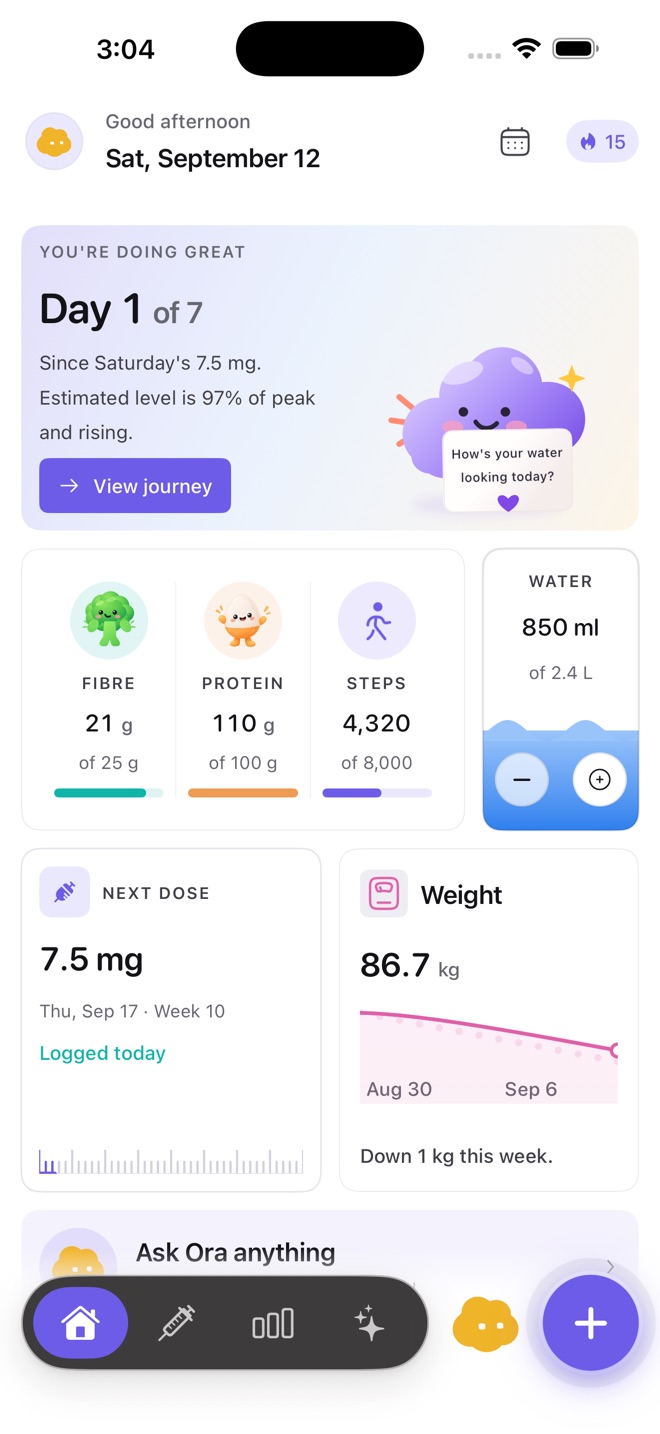
If your scale writes body-fat or lean-mass readings to Apple Health, Cafeity can show them next to your weight. Protein sits on the Today screen against your target, so the days it falls short — often the days after a dose — are visible.

Common questions
How much muscle do you lose on a GLP-1?
How can I prevent muscle loss on a GLP-1?
How much protein should I eat to keep muscle?
Sources
- Body composition changes during weight reduction with tirzepatide in the SURMOUNT-1 study Look M et al. Diabetes, Obesity and Metabolism 2025
- Changes in lean body mass with glucagon-like peptide-1-based therapies and mitigation strategies Neeland IJ, Linge J, Birkenfeld AL. Diabetes, Obesity and Metabolism 2024
- Nutritional priorities to support GLP-1 therapy for obesity: a joint advisory from the American College of Lifestyle Medicine, the American Society for Nutrition, the Obesity Medicine Association and The Obesity Society Mozaffarian D et al. 2025 (published in four journals)
- Semaglutide injection and tablets for weight management — US prescribing information DailyMed, US National Library of Medicine, version published 30 June 2026
- Tirzepatide injection for weight management and obstructive sleep apnoea — US prescribing information DailyMed, US National Library of Medicine, version published 2 September 2026
Written by the Cafeity team from the sources listed here. Figures from prescribing information are quoted as the label states them; trial results are averages from those trials, not predictions for any one person. This page has not yet been reviewed by a clinician — see the editorial policy for how pages are researched and corrected.