
Why appetite disappears
That is the medicine working: the labels describe semaglutide and tirzepatide as reducing calorie intake, likely by affecting appetite, through GLP-1 receptors in the brain regions that regulate it.13 Slower stomach emptying adds a lingering fullness. On a weekly injection, many people find appetite lowest in the day or two after the dose.
Eat by the clock, not by hunger
The joint advisory suggests breakfast and then small meals every three to four hours to avoid a cycle of not eating and feeling worse.2 Setting two or three meal times — and a reminder — replaces a hunger cue that is no longer reliable.
Foods that go down on low days
| Easy option | Why it works | Protein per portion |
|---|---|---|
| Greek yoghurt, plain, non-fat (170 g pot) | Cold, soft, no cooking | about 17.5 g |
| Cottage cheese, 2% (½ cup) | Small volume, high protein | about 12.4 g |
| Eggs (1 large, hard-boiled) | Keep a few ready in the fridge | about 6.3 g |
| Milk, skimmed (1 cup) | Drinkable | about 8.3 g |
| Tofu, firm (½ cup) | Soft, takes any flavour | about 21.8 g |
| Lentil or bean soup | Protein and fibre, easy to sip | about 9 g per ½ cup of lentils |
Source: USDA FoodData Central.4 Protein drinks and shakes are another option; check the label for protein and sugar.
When too little becomes a problem
The joint advisory warns that very low intakes — below about 1,200 kcal a day for women and 1,800 for men — make nutrient shortfalls more likely, and that protein should not fall below about 0.4–0.5 g per kg a day.2 The labels add that substantial or rapid weight loss can increase the risk of gallstones.1 If your intake has dropped a long way, or you feel weak, dizzy or unwell, tell your prescriber; it is a common reason to review treatment.
When to contact your prescriber
Keeping a record of it
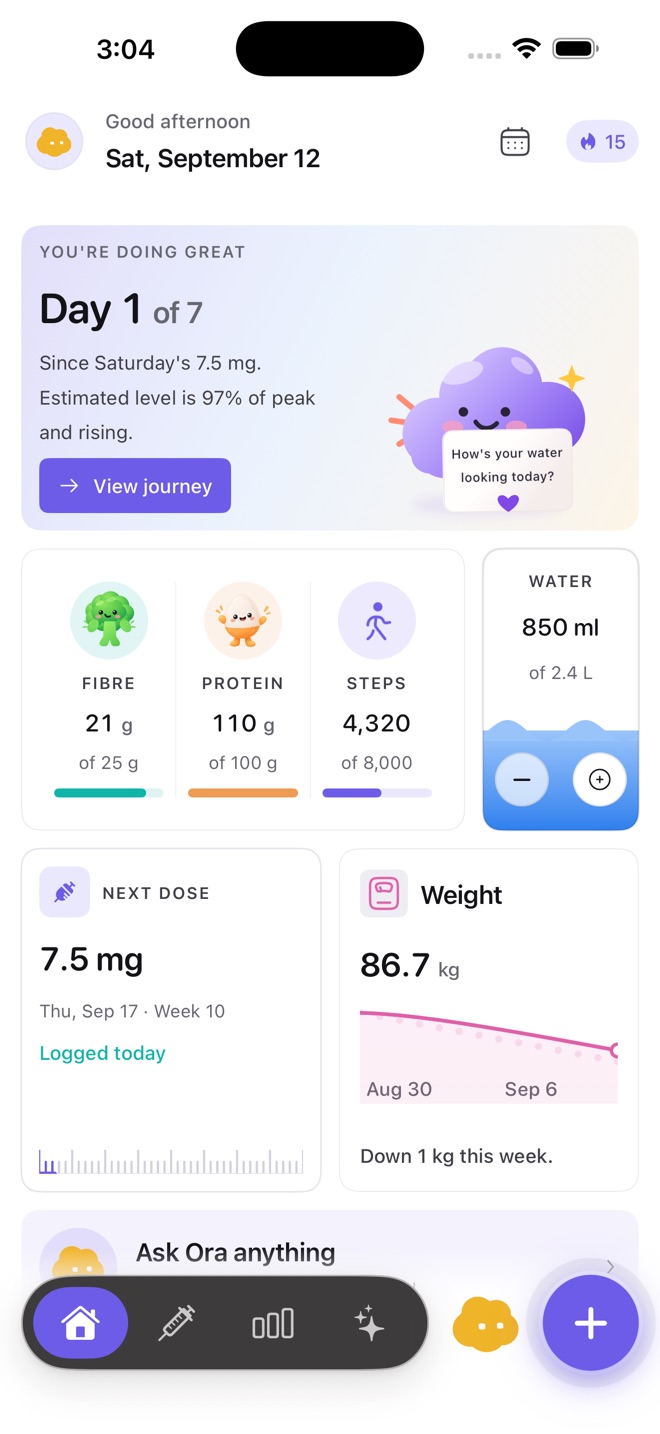
Cafeity shows protein, fibre and water against their reference figures on the Today screen, so a low day is visible by lunchtime rather than at bedtime — and quick-add means a protein shake is one tap.

Common questions
What should I eat on a GLP-1 when I am not hungry?
Is it bad to skip meals on a GLP-1?
Sources
- Semaglutide injection and tablets for weight management — US prescribing information DailyMed, US National Library of Medicine, version published 30 June 2026
- Nutritional priorities to support GLP-1 therapy for obesity: a joint advisory from the American College of Lifestyle Medicine, the American Society for Nutrition, the Obesity Medicine Association and The Obesity Society Mozaffarian D et al. 2025 (published in four journals)
- Tirzepatide injection for weight management and obstructive sleep apnoea — US prescribing information DailyMed, US National Library of Medicine, version published 2 September 2026
- FoodData Central US Department of Agriculture, Agricultural Research Service
Written by the Cafeity team from the sources listed here. Figures from prescribing information are quoted as the label states them; trial results are averages from those trials, not predictions for any one person. This page has not yet been reviewed by a clinician — see the editorial policy for how pages are researched and corrected.