

How common it is
Every GLP-1 medicine lists nausea among its most common adverse reactions, and it is the reaction most often given as a reason for stopping. The figures below are the percentage of people in each medicine's placebo-controlled trials who reported it at least once.
| Medicine (trial population) | Placebo | Medicine |
|---|---|---|
| Semaglutide 2.4 mg weekly injection (weight management) | 16% | 44% |
| Semaglutide 7.2 mg weekly injection (weight management) | 13% | 39% (35% on 2.4 mg in the same trials) |
| Tirzepatide weekly injection (weight management) | 8% | 25% (5 mg), 29% (10 mg), 28% (15 mg) |
| Liraglutide 3 mg daily injection (weight management) | 13.8% | 39.3% |
| Orforglipron daily tablet (weight management) | 10% | 26% (5.5 mg), 34% (9 mg), 35% (17.2 mg) |
| Semaglutide weekly injection (type 2 diabetes) | 6.1% | 15.8% (0.5 mg), 20.3% (1 mg) |
| Tirzepatide weekly injection (type 2 diabetes) | 4% | 12% (5 mg), 15% (10 mg), 18% (15 mg) |
| Dulaglutide weekly injection (type 2 diabetes) | 5.3% | 12.4% (0.75 mg), 21.1% (1.5 mg) |
| Exenatide twice-daily injection (type 2 diabetes) | 18% | 44% |
Two patterns stand out. Nausea was reported more often in the weight-management trials than in the type 2 diabetes trials — semaglutide and liraglutide are used at higher doses for weight management, and the populations differ. And within one medicine it tends to rise with the dose.24 It also sits inside a wider cluster: in the semaglutide 2.4 mg trials, 73% of people reported some gastrointestinal reaction, against 47% on placebo.1
Most of it is mild. In the orforglipron trials, of the people who had a gastrointestinal reaction, 60% described it as mild, 36% moderate and 4% severe; in the liraglutide trials most episodes were mild or moderate and did not lead anyone to stop.43 Severe gastrointestinal reactions were reported by 4.1% of people on semaglutide 2.4 mg injections, against 0.9% on placebo.1
Why it happens
Two mechanisms show up in the prescribing information. The first is in the stomach: these medicines slow gastric emptying, so food sits in the stomach for longer. For tirzepatide the label adds that the delay is largest after the first dose and diminishes over time.12 A fuller stomach for longer is a plausible reason a normal-sized meal can suddenly feel like too much.
The second is in the brain. GLP-1 is a natural regulator of appetite, and the receptor these medicines act on is found in several brain areas involved in appetite regulation.1 The effect people want — feeling full sooner and thinking about food less — and the effect they do not want can come from the same place.
That is also why the dose matters. The labels' recommended schedules start low and step up over weeks or months precisely to reduce gastrointestinal reactions; the orforglipron label says so in as many words.4 How fast to step up is a decision for the prescriber, never for an app.
When it tends to happen
The labels are consistent about the broad timing. For semaglutide, gastrointestinal reactions were "most frequently reported during dosage escalation". For tirzepatide, most nausea, vomiting and diarrhoea happened during dose escalation and decreased over time. For orforglipron, nausea was more common during the escalation period and decreased after it.124
Within a week, the timing is more personal. Blood levels of semaglutide peak 1 to 3 days after an injection; tirzepatide peaks at a median of about 24 hours.12 Plenty of people notice their queasiest day falls in that window. Plenty do not. Meal size, what was eaten, sleep, alcohol and another illness all move it about, which is why a few weeks of your own record says more than any general rule.
For the fuller picture of how side effects change across the first months, see when GLP-1 side effects start and how long they last.
What people commonly try
A 2025 joint advisory from four US nutrition and obesity-medicine organisations sets out practical eating strategies for people on these medicines. For nausea, it suggests:5
- Smaller, more frequent meals rather than three large ones — a stomach that empties slowly copes better with less at a time.
- Going easy on fatty foods, and on very high-fibre foods while the nausea is at its worst; lower-fibre fruit and vegetables are easier then.
- Not skipping meals — eating breakfast and then something small every three to four hours, to avoid a cycle of not eating and feeling worse for it.
- Ginger or peppermint tea, or acupressure bands, which some people find settling.
- Anti-sickness medicine, which is a conversation for your prescriber or pharmacist.
Two more things follow from how the medicines work. Stopping at the first sign of fullness is worth practising: with the stomach emptying more slowly, a few extra mouthfuls can tip comfortable into queasy. And alcohol is worth watching: the same advisory notes it may worsen nausea and reflux on these medicines.5
None of this replaces advice from the person who prescribed the medicine. If nausea is making it hard to eat or drink, tell them — the schedule itself can be discussed.
Eating when everything looks unappealing
When appetite is low and the stomach is unsettled, the risk shifts from eating too much to eating too little — especially too little protein and fluid. Small, plain portions tend to go down more easily than large, rich ones. Many people lean on things like plain yoghurt, eggs, crackers, toast, rice, soup or a protein drink sipped slowly, and come back to fuller meals as the nausea eases.
Fluids matter most. Vomiting and diarrhoea can lead to dehydration, and the labels warn that dehydration from gastrointestinal side effects has led to kidney problems; the patient information for tirzepatide says it is important to drink fluids to help reduce the chance of dehydration.21 Small, frequent sips are easier than a large glass.
For more on getting protein in on a low-appetite day, see eating with no appetite and the printable protein food list.
When to contact your prescriber
Keeping a record of it
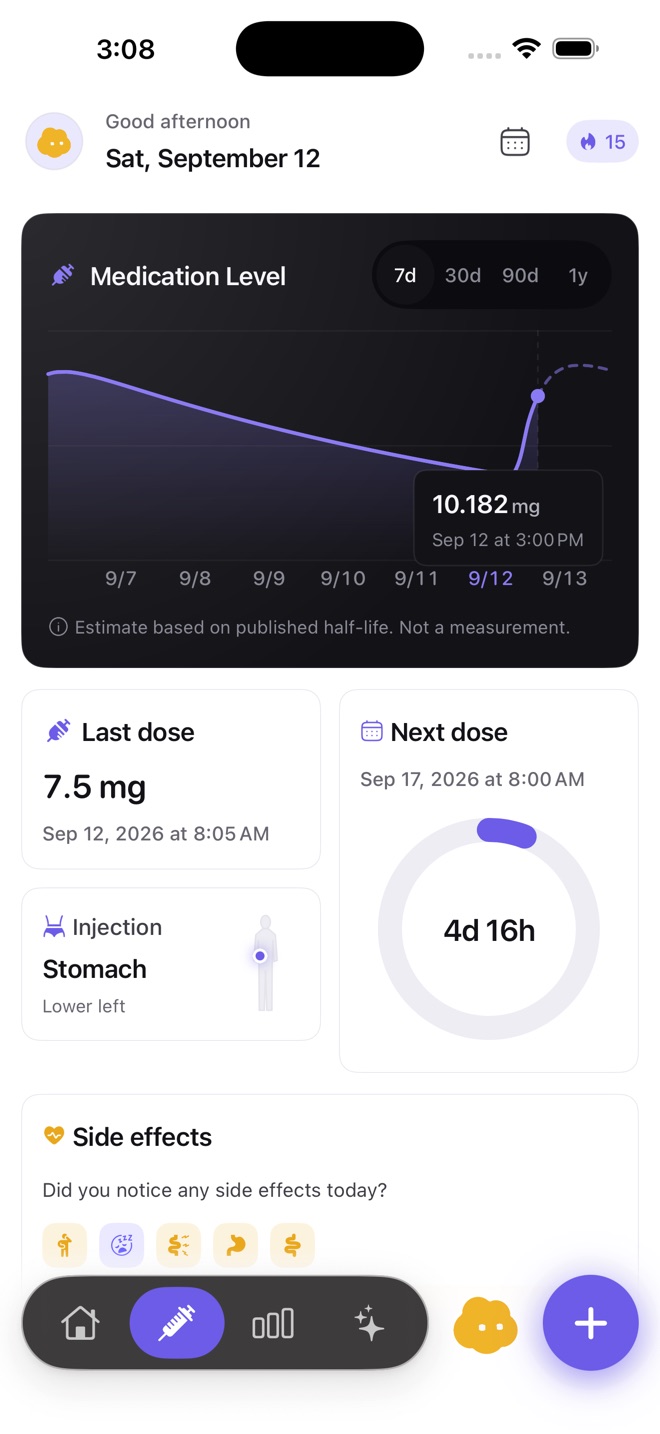
The useful record is not "felt sick this week" but when, how badly, and against what: the day since your dose, whether the dose changed recently, what you ate. Cafeity logs nausea with a severity and a time on the same timeline as your doses, and Ora can answer "when are my symptoms worst?" from your own entries. The Visit Summary puts it in front of your prescriber on one page.

Common questions
How long does GLP-1 nausea last?
Is nausea worse the day after the injection?
Does nausea mean the medicine is working?
Can I take an anti-sickness tablet?
Is nausea on the tablet different from the injection?
Sources
- Semaglutide injection and tablets for weight management — US prescribing information DailyMed, US National Library of Medicine, version published 30 June 2026
- Tirzepatide injection for weight management and obstructive sleep apnoea — US prescribing information DailyMed, US National Library of Medicine, version published 2 September 2026
- Liraglutide 3 mg injection for weight management — US prescribing information DailyMed, US National Library of Medicine, version published 15 June 2026
- Orforglipron tablets for weight management — US prescribing information DailyMed, US National Library of Medicine, version published 13 August 2026
- Nutritional priorities to support GLP-1 therapy for obesity: a joint advisory from the American College of Lifestyle Medicine, the American Society for Nutrition, the Obesity Medicine Association and The Obesity Society Mozaffarian D et al. 2025 (published in four journals)
- Managing the gastrointestinal side effects of GLP-1 receptor agonists in obesity: recommendations for clinical practice Wharton S et al. Postgraduate Medicine 2022;134(1):14–19
Written by the Cafeity team from the sources listed here. Figures from prescribing information are quoted as the label states them; trial results are averages from those trials, not predictions for any one person. This page has not yet been reviewed by a clinician — see the editorial policy for how pages are researched and corrected.