
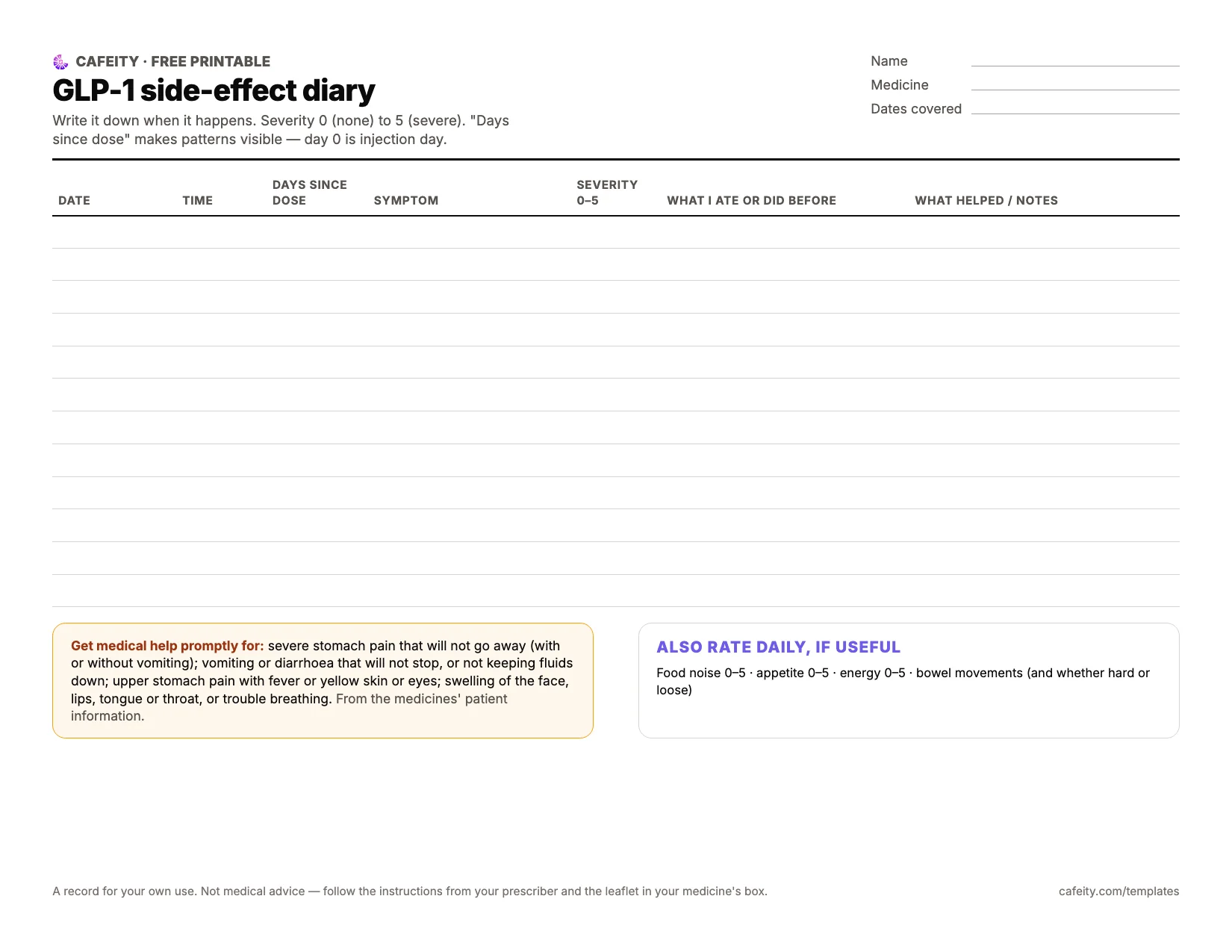
Why "days since dose" is the key column
Most side effects of GLP-1 medicines are gastrointestinal, and the labels describe them as most common during dose increases.21 Within each week, many people also notice them clustering a day or two after an injection, when levels peak — 1 to 3 days after semaglutide and about a day after tirzepatide.21 Writing down "day 1" or "day 5" next to each symptom turns a vague impression into a pattern you can see — and show.
How to fill it in
- Write it when it happens, or the same evening. Memory rounds everything off by the time of the appointment.
- Day 0 is dose day; count up from there. For daily tablets, note the time of the tablet instead.
- Severity 0–5: 1 is noticeable, 3 is getting in the way of the day, 5 is the worst you can imagine.
- "What I ate or did before" catches triggers — a large or fatty meal, alcohol, a missed meal, poor sleep.
- "What helped" is for you, and for your prescriber: smaller meals, a walk, a particular food, time.
There is space at the foot of the page to rate food noise, appetite and energy daily as well — see food noise for why that is worth doing.
The warning signs on the page
The diary is for ordinary, expected side effects. The box on the page repeats the signs the patient medication guides say should not be written down and waited out:12 severe stomach pain that will not go away; vomiting or diarrhoea that will not stop; upper stomach pain with fever or yellowing of the skin or eyes; and swelling of the face, lips, tongue or throat or trouble breathing. For those, contact a clinician promptly or get emergency help.
Common questions
What should I record about side effects?
Should I report side effects to anyone else?
Is this the same as the app?
Sources
- Tirzepatide injection for weight management and obstructive sleep apnoea — US prescribing information DailyMed, US National Library of Medicine, version published 2 September 2026
- Semaglutide injection and tablets for weight management — US prescribing information DailyMed, US National Library of Medicine, version published 30 June 2026
- MedWatch — report a side effect to the FDA US Food and Drug Administration
- Yellow Card — report a suspected side effect (UK) Medicines and Healthcare products Regulatory Agency
Written by the Cafeity team from the sources listed here. Figures from prescribing information are quoted as the label states them; trial results are averages from those trials, not predictions for any one person. This page has not yet been reviewed by a clinician — see the editorial policy for how pages are researched and corrected.