

What the labels ask you to tell your prescriber
The patient medication guides for these medicines contain a list of things to tell your healthcare provider before starting. It is the most reliable starting point for any appointment, because it is exactly what the manufacturer and the regulator think a prescriber needs to know:123
- Any history of pancreatitis or other pancreas problems.
- Severe stomach problems, such as slowed stomach emptying (gastroparesis) or trouble digesting food.
- Diabetic retinopathy or other eye problems, if you have diabetes.
- Any planned surgery or procedure involving anaesthesia or deep sedation.
- Whether you are pregnant, planning a pregnancy, or breastfeeding.
- If you use birth control pills — some GLP-1 labels say oral contraceptives may work less well for a time after starting and after dose increases.
- Every other medicine you take, including over-the-counter medicines, vitamins and herbal supplements — especially insulin or a sulfonylurea for diabetes.
- Any personal or family history of medullary thyroid carcinoma or multiple endocrine neoplasia type 2 (MEN 2).
- Any previous serious allergic reaction to the medicine or another GLP-1.
Questions before you start
- Which medicine, which form (weekly injection or daily tablet), and why this one for me?
- What is the plan for the dose — how will it change over the first months, and who decides when?
- How and where do I inject, and will someone show me the first time? (The labels expect a healthcare provider to show you before your first injection.)1
- Which side effects are expected, and which ones mean I should call you — and who do I call out of hours?
- What should I do if I miss a dose? (Each medicine has its own rule in its patient information.)
- Does this change anything about my other medicines, or my contraception?
- How should I store it, including when I travel?
- How much will it cost, and for how long is it likely to be prescribed?
Questions at follow-up appointments
- Is my progress what you would expect at this stage? What are you looking at to judge it?
- When will we review whether to continue, change or stop? (In England, for example, NICE guidance asks for a review if less than 5% of starting weight has been lost after six months.)45
- Should the dose change — and what would make you decide either way?
- Is my protein and overall eating enough? Should I see a dietitian?
- Should I be doing strength training, and is there anything I should avoid?
- Do I need any blood tests — for example, if my eating has dropped a lot?
- Are my other conditions or medicines changing because of the weight change (blood pressure, diabetes medicines)?
The 2025 joint nutrition advisory recommends that clinicians regularly reassess what people on these medicines are eating and watch for nutrient shortfalls, particularly when intake falls a long way.6 It is a fair thing to ask about.
Questions about side effects
- This side effect has lasted this long — is that expected, or should we change something?
- Can I take something for the nausea, constipation or reflux, and is it safe with my other medicines?
- My side effects came back after the last dose increase — should we slow down?
- What exactly are the warning signs of pancreatitis, gallbladder problems and dehydration?
Bring specifics: which symptom, how strong, how often, and how it lines up with your doses. "Nausea 3 out of 5, the two days after each injection, worse since the dose went up on the 14th" is something a prescriber can act on.
Questions about stopping or changing
- How long do you expect me to take this?
- What happens to my weight and appetite if I stop? (In trials that stopped treatment, much of the lost weight tended to return within a year.)78
- If I stop, should anything else change first — eating, activity, other medicines?
- Could I switch to a different medicine or form, and what would that involve?
- What should I do before surgery, a procedure, or a planned pregnancy?
Bring a record, not a memory
Most of these questions are answered faster with data. A useful record for an appointment covers:
- Every dose, with the date and the amount you were prescribed, and any missed or late doses.
- Your weight as a trend over weeks, not a single reading.
- Side effects with their dates and severity.
- Roughly what you are eating — especially protein, fibre and fluids.
- Your own questions, written down in advance.
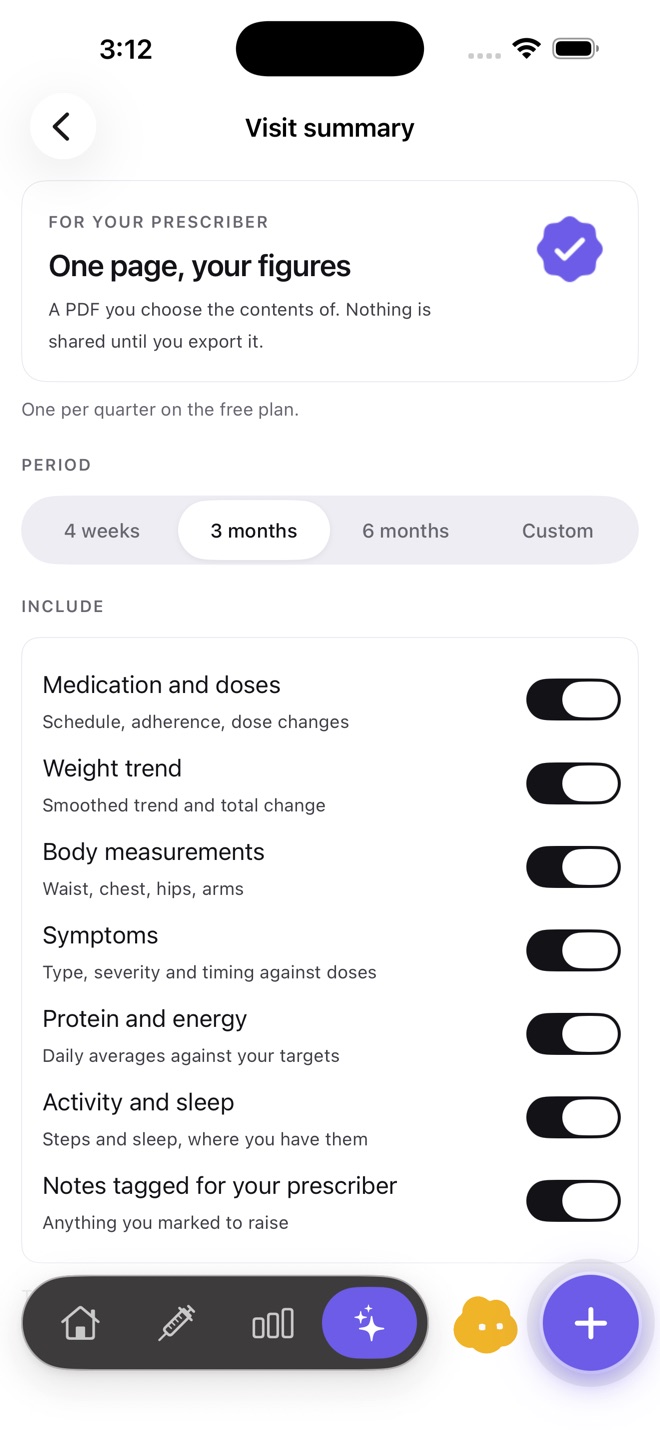
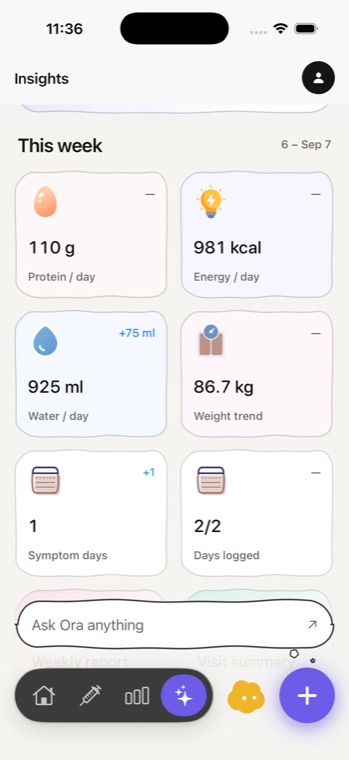
The free printable GLP-1 tracker and side-effect diary cover this on paper. Cafeity's Visit Summary builds the same page from your log — doses and adherence, the weight trend, symptoms against doses, nutrition, and the notes you tagged for your prescriber.
Keeping a record of it
In Cafeity, any note can be tagged "for my prescriber", and the Visit Summary gathers those notes with your doses, weight trend, symptoms and nutrition into a single print-ready page for the period you choose. Nothing is shared until you export it.
Common questions
What should I ask before starting a GLP-1?
What should I tell my doctor before a GLP-1?
How often should I see my prescriber on a GLP-1?
Is there a printable version?
Sources
- Tirzepatide injection for weight management and obstructive sleep apnoea — US prescribing information DailyMed, US National Library of Medicine, version published 2 September 2026
- Semaglutide injection and tablets for weight management — US prescribing information DailyMed, US National Library of Medicine, version published 30 June 2026
- Orforglipron tablets for weight management — US prescribing information DailyMed, US National Library of Medicine, version published 13 August 2026
- Semaglutide for managing overweight and obesity (TA875) National Institute for Health and Care Excellence
- Tirzepatide for managing overweight and obesity (TA1026) National Institute for Health and Care Excellence
- Nutritional priorities to support GLP-1 therapy for obesity: a joint advisory from the American College of Lifestyle Medicine, the American Society for Nutrition, the Obesity Medicine Association and The Obesity Society Mozaffarian D et al. 2025 (published in four journals)
- Weight regain and cardiometabolic effects after withdrawal of semaglutide: the STEP 1 trial extension Wilding JPH et al. Diabetes, Obesity and Metabolism 2022;24:1553–1564
- Continued treatment with tirzepatide for maintenance of weight reduction in adults with obesity (SURMOUNT-4) Aronne LJ et al. JAMA 2024;331(1):38–48
Written by the Cafeity team from the sources listed here. Figures from prescribing information are quoted as the label states them; trial results are averages from those trials, not predictions for any one person. This page has not yet been reviewed by a clinician — see the editorial policy for how pages are researched and corrected.