

How common it is
Constipation appears on every GLP-1 label as a common reaction, and at weight-management doses it is reported by roughly one person in five.
| Medicine (trial population) | Placebo | Medicine |
|---|---|---|
| Semaglutide 2.4 mg weekly injection (weight management) | 11% | 24% |
| Semaglutide 7.2 mg weekly injection (weight management) | 8% | 20% (19% on 2.4 mg in the same trials) |
| Tirzepatide weekly injection (weight management) | 5% | 17% (5 mg), 14% (10 mg), 11% (15 mg) |
| Liraglutide 3 mg daily injection (weight management) | 8.5% | 19.4% |
| Orforglipron daily tablet (weight management) | 9% | 20% (5.5 mg), 27% (9 mg), 24% (17.2 mg) |
| Semaglutide weekly injection (type 2 diabetes) | 1.5% | 5% (0.5 mg), 3.1% (1 mg) |
| Tirzepatide weekly injection (type 2 diabetes) | 1% | 6% (5 mg), 6% (10 mg), 7% (15 mg) |
Unlike nausea, constipation does not simply rise with the dose — on tirzepatide it was reported slightly less at the higher doses.2 It is also the reaction most likely to persist after the queasy early weeks, which is why it is worth getting ahead of rather than waiting out.
Why it happens
Three things stack up. The medicines slow the movement of food through the stomach — tirzepatide's label notes the effect is strongest after the first dose.12 People eat noticeably less, which means less bulk and often less fibre reaching the bowel. And a smaller appetite usually comes with a smaller thirst, so fluid intake drops too.
Each on its own might be manageable. Together, they are a recipe for harder, less frequent stools — and the fix is mostly about putting back the fibre and fluid that the appetite change quietly took away.
What the guidance suggests
The 2025 joint advisory on nutrition during GLP-1 therapy — from the American College of Lifestyle Medicine, the American Society for Nutrition, the Obesity Medicine Association and The Obesity Society — puts it in this order:5
- Adequate fluids. Drinking enough is the first step; a smaller appetite makes it easy to fall behind without noticing.
- Fibre from food. Vegetables, fruit, pulses, wholegrains, nuts and seeds. US reference intakes are about 25 g a day for women and 38 g for men up to 50; UK guidance is 30 g for adults.67
- If that is not enough, the advisory lists options clinicians use — fibre supplements, magnesium citrate, polyethylene glycol, or a stool softener to avoid straining. Which one, and how much, is a question for a pharmacist or prescriber, especially if you take other medicines.
Two practical notes. Fibre works best increased gradually and with fluid alongside it — adding a lot at once can cause bloating, which on a slower gut is no small thing. And physical activity helps keep the bowel moving in general — even a daily walk counts.
The fibre and water calculators show the reference figures Cafeity uses: fibre intake and water intake.
Fibre that fits a smaller appetite
When portions shrink, fibre has to come from denser sources. Some that work well in small amounts:
- Pulses — lentils, chickpeas and beans carry fibre and protein together, which matters when every mouthful has to earn its place. Boiled lentils have about 8 g of fibre per 100 g; black beans about 9 g.8
- Oats and wholegrains — porridge, wholegrain bread, brown rice.
- Fruit with skin, and berries.
- Vegetables — cooked often sit more comfortably than large raw salads on a slow stomach.
- Nuts and seeds — almonds have about 12 g of fibre per 100 g, though they are energy-dense.8
If nausea is also a problem, the same advisory suggests leaning towards lower-fibre, softer foods while the nausea is at its worst, then building fibre back up.5 The two side effects pull in slightly different directions, which is one more reason to log both.
When constipation is more than constipation
Rarely, a slowed gut becomes a blocked one. The semaglutide label lists ileus, intestinal obstruction and severe constipation including faecal impaction among reactions reported after approval.1 These are uncommon, but they are emergencies, and the signs are different from ordinary constipation: severe or worsening stomach pain, a swollen or hard abdomen, vomiting, and being unable to pass stool or wind.
Severe, persistent stomach pain can also be a sign of pancreatitis or gallbladder disease, both listed in the warnings on every GLP-1 label.12
When to contact your prescriber
Keeping a record of it
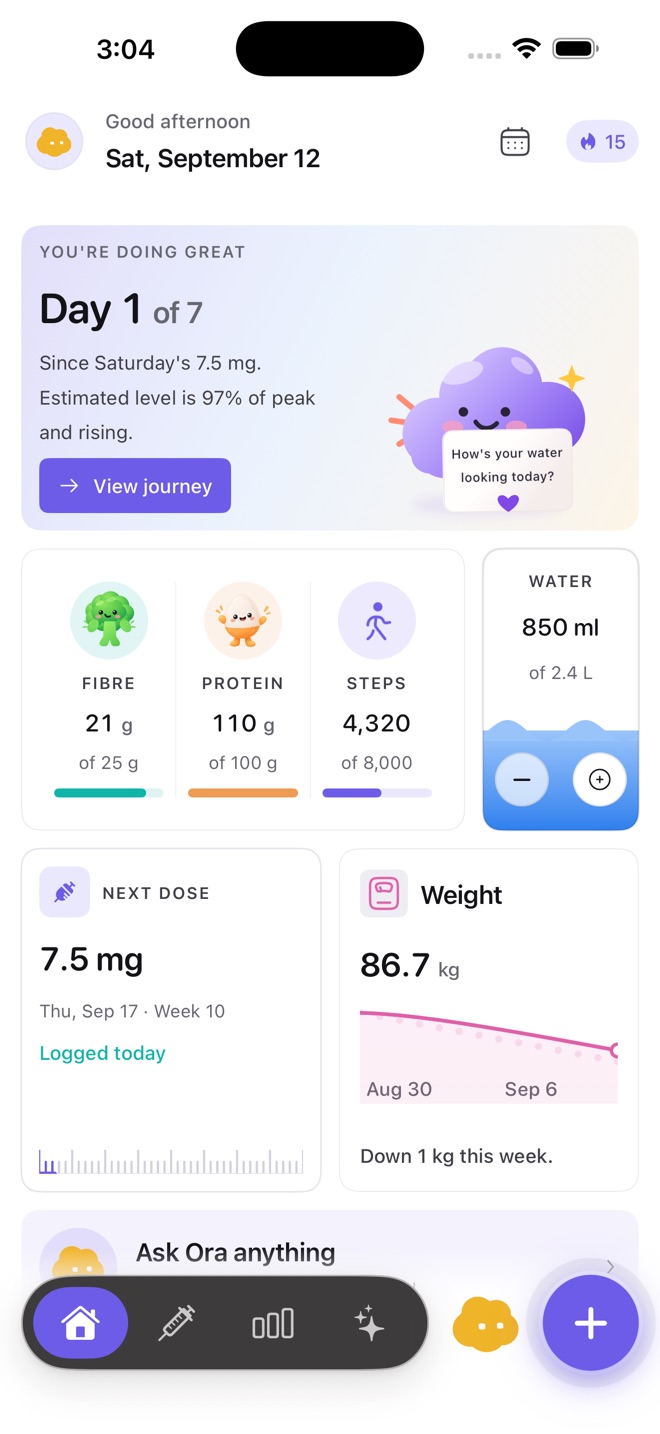
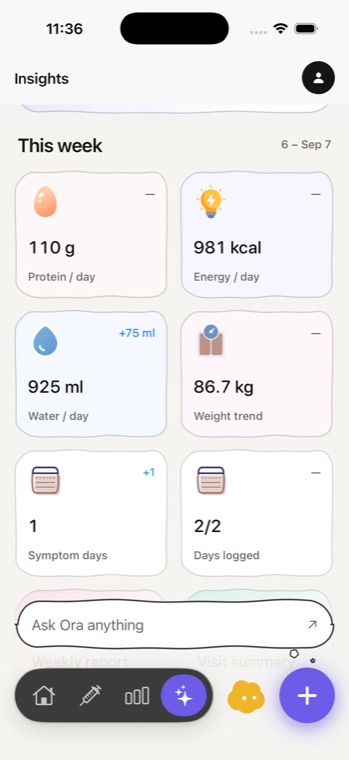
Cafeity has a bowel log alongside its symptom log, so constipation can be recorded as it happens rather than reconstructed from memory — next to your fibre, water and doses on the same day. Over a few weeks the record shows whether it tracks with low-fibre days, dose increases or neither.
Common questions
How long does GLP-1 constipation last?
Should I take a laxative?
Can constipation on a GLP-1 be dangerous?
Why do I have constipation and diarrhoea?
Sources
- Semaglutide injection and tablets for weight management — US prescribing information DailyMed, US National Library of Medicine, version published 30 June 2026
- Tirzepatide injection for weight management and obstructive sleep apnoea — US prescribing information DailyMed, US National Library of Medicine, version published 2 September 2026
- Liraglutide 3 mg injection for weight management — US prescribing information DailyMed, US National Library of Medicine, version published 15 June 2026
- Orforglipron tablets for weight management — US prescribing information DailyMed, US National Library of Medicine, version published 13 August 2026
- Nutritional priorities to support GLP-1 therapy for obesity: a joint advisory from the American College of Lifestyle Medicine, the American Society for Nutrition, the Obesity Medicine Association and The Obesity Society Mozaffarian D et al. 2025 (published in four journals)
- Dietary Reference Intakes for Energy, Carbohydrate, Fiber, Fat, Fatty Acids, Cholesterol, Protein, and Amino Acids Institute of Medicine, National Academies Press (2005)
- Carbohydrates and Health Scientific Advisory Committee on Nutrition, UK (2015)
- FoodData Central US Department of Agriculture, Agricultural Research Service
Written by the Cafeity team from the sources listed here. Figures from prescribing information are quoted as the label states them; trial results are averages from those trials, not predictions for any one person. This page has not yet been reviewed by a clinician — see the editorial policy for how pages are researched and corrected.