
What "lean" means on a food label
"Lean" on a US package is a nutrient content claim under FDA rule 21 CFR 101.62(e). It caps total fat, saturated fat and cholesterol for that food type and serving. It doesn't say a food is healthy, or right for you. "Extra lean" has lower caps. Log what you actually eat, and take diet questions to your doctor or dietitian.
Disclosure: Cafeity is made by the author.
What the FDA rule says
The rule is paragraph (e) of 21 CFR 101.62, the FDA regulation on nutrient content claims for fat, fatty acids and cholesterol. In plain terms:
- "Lean" on a seafood or game meat product means the food, as packaged, stays under set amounts of total fat, saturated fat and cholesterol, both per reference amount customarily consumed (RACC) and per 100 g.
- "Lean" on a mixed dish not measurable with a cup uses lower caps, per RACC.
- "Lean" on a meal or main dish is measured per 100 g and per labeled serving.
- "Extra lean" on a discrete seafood or game meat product has lower caps again, per RACC and per 100 g.
- "Extra lean" on a meal or main dish uses the same lower caps, per 100 g and per labeled serving.
RACC stands for reference amount customarily consumed: the amount of a type of food that the rule measures against.
The cutoffs, by food type
| Food type (paragraph) | Measured | "Lean" | "Extra lean" |
|---|---|---|---|
| Seafood or game meat product; "extra lean" needs a discrete one ((e)(1), (e)(4)) | Per RACC and per 100 g | Less than 10 g total fat, 4.5 g or less saturated fat, less than 95 mg cholesterol | Less than 5 g total fat, less than 2 g saturated fat, less than 95 mg cholesterol |
| Mixed dish not measurable with a cup ((e)(2)) | Per RACC | Less than 8 g total fat, 3.5 g or less saturated fat, less than 80 mg cholesterol | No extra lean cutoff in the rule |
| Meal or main dish ((e)(3), (e)(5)) | Per 100 g and per labeled serving | Less than 10 g total fat, 4.5 g or less saturated fat, less than 95 mg cholesterol | Less than 5 g fat, less than 2 g saturated fat, less than 95 mg cholesterol |
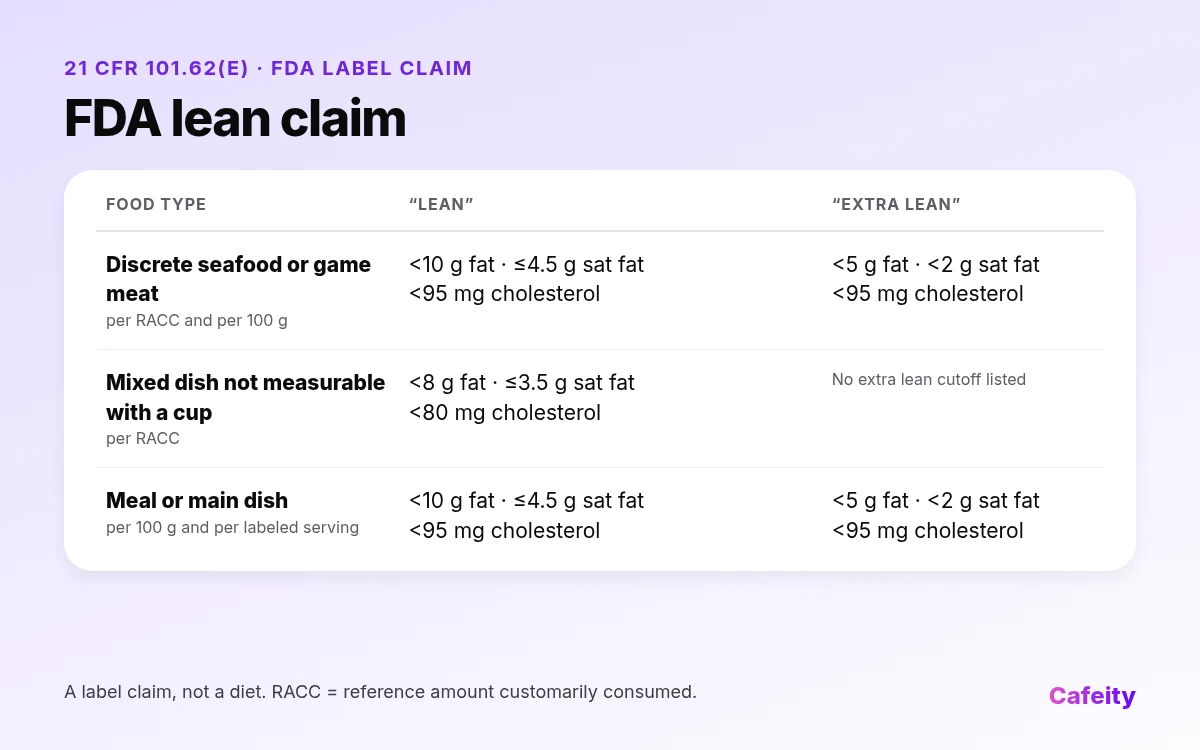
Notice the cholesterol cap: it is the same, less than 95 mg, for lean and extra lean on seafood, game meat and meals. What changes between the two words is the fat and saturated fat.
"Lean meats" in the Dietary Guidelines is a different thing
The Dietary Guidelines for Americans, 2020 to 2025, describe protein foods as including "lean meats, poultry, and eggs; seafood; beans, peas, and lentils; and nuts, seeds, and soy products." That is a description of a kind of food, not a label rule, and it has no cutoffs attached.
Searches for a lean protein diet often mix the two up. The label word is a legal cap on fat, saturated fat and cholesterol for one package. The Guidelines' phrase is a way of describing protein foods. Neither one is a diet for you. For protein foods in general, read high-protein foods, and for cost, protein on a budget.
What the word doesn't tell you
- Not a protein amount. The rule says nothing about protein. Read the protein line on the Nutrition Facts panel, or see the protein food list.
- Not a calorie amount. Calories are on the panel, not in the claim.
- Not a verdict on the food. "Lean" means the food is under three caps. It doesn't make a food good or bad, and it doesn't say the food fits you.
If a package says lean, check the label for the type of food and the amount the claim is measured on. What fits your diet is a question for your doctor or a registered dietitian; see questions to ask your doctor.
Logging it in Cafeity
Log a lean food like any other. Food logging in Cafeity gives four ways to record a meal: a photo, a search, a barcode or a quick number. Log what you actually ate, in the amount you ate. Cafeity keeps the record.
Cafeity is on the App Store for iPhone. There is no Android version yet.
Common questions
What does "lean" mean on a food label?
It is an FDA nutrient content claim defined in 21 CFR 101.62(e). It caps total fat, saturated fat and cholesterol. For a seafood or game meat product, lean means less than 10 g fat, 4.5 g or less saturated fat and less than 95 mg cholesterol per reference amount customarily consumed and per 100 g.
What does "extra lean" mean?
Lower caps on the same three nutrients. For a discrete seafood or game meat product, and for a meal or main dish, extra lean means less than 5 g total fat, less than 2 g saturated fat and less than 95 mg cholesterol. The rule sets no extra lean cutoff for a mixed dish not measurable with a cup.
Does "lean" mean a food is healthy?
No. The word only says the food stays under the fat, saturated fat and cholesterol caps in the FDA rule. It does not tell you the protein, the calories or anything else about the food, and it does not say the food is right for you. Read the Nutrition Facts panel and ask your doctor or dietitian.
Is "lean" on a label the same as "lean meats" in the Dietary Guidelines?
No. The label word is a legal claim with fixed cutoffs under 21 CFR 101.62(e). The 2020 to 2025 Dietary Guidelines use "lean meats" as a description inside their list of protein foods, alongside poultry, eggs, seafood, beans, peas, lentils, nuts, seeds and soy products. One is a label rule; the other is not.
How do I log a lean food in Cafeity?
Log it like any other food: Cafeity gives four ways to record a meal, a photo, a search, a barcode or a quick number. Log what you actually ate, in the amount you ate. Cafeity keeps the record. For questions about your diet, talk to your doctor or a registered dietitian.
Sources
- 21 CFR 101.62, nutrient content claims for fat, fatty acid, and cholesterol content of foods: paragraph (e), "lean" and "extra lean" (eCFR, read 25 Oct 2026).
- Dietary Guidelines for Americans, 2020 to 2025: protein foods, including lean meats.
Related pages
Keep a record of what you eat
Log it on the day, in the amount you ate. Your doctor or dietitian tells you what fits.