
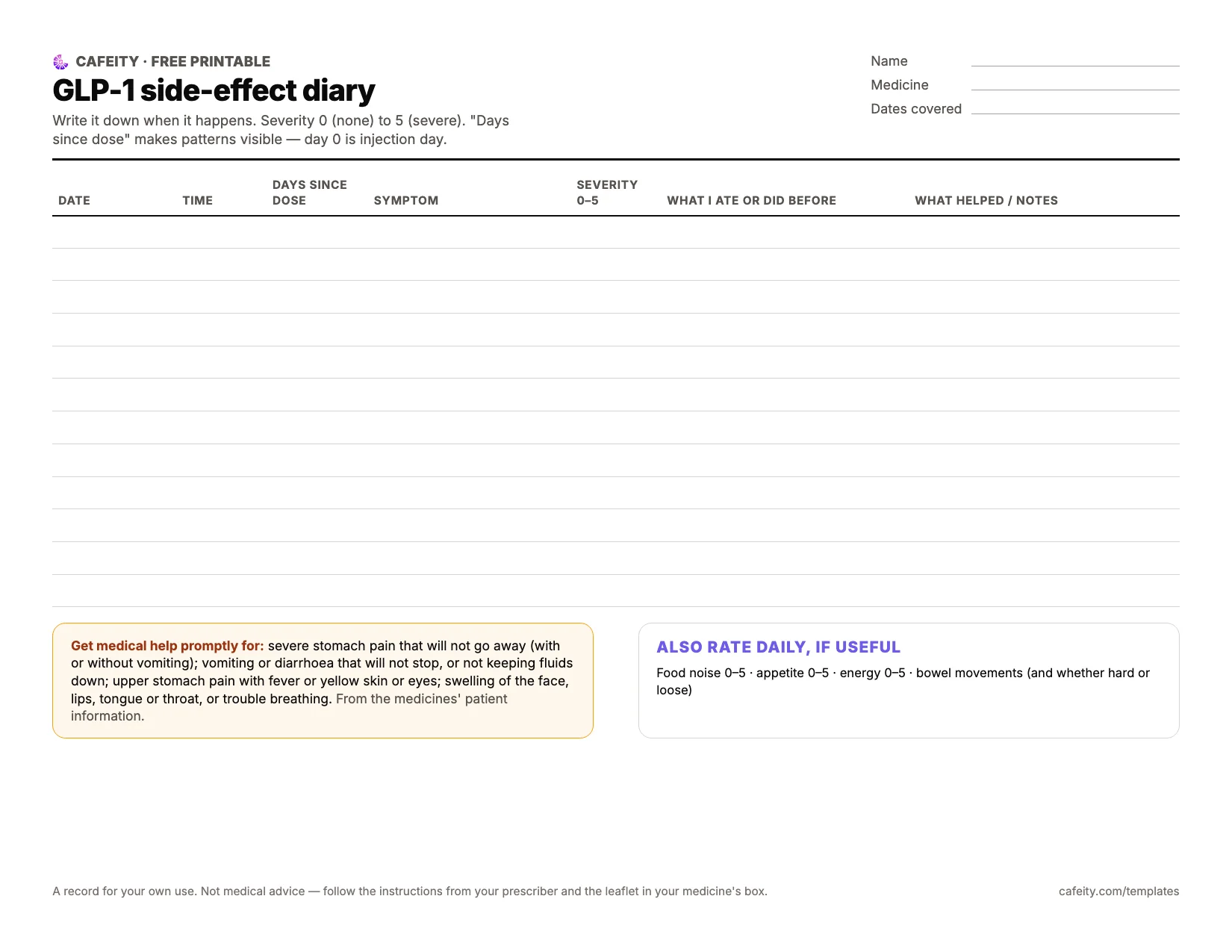
Why structure beats memory
Memory is a poor record of symptoms. At an appointment, most people remember the worst day and the most recent one, and lose the pattern in between. The pattern is often what matters: a symptom that clusters in the day or two after each dose, settles over the following weeks, or follows rich meals or alcohol points somewhere different from one that is steadily getting worse.
The labels report how often each side effect appeared in trials — nausea, diarrhoea, vomiting and constipation are among the commonest23 — and many ease with time; see what the labels report and when side effects start and how long they last. Your record shows where you sit against that.
The six details worth recording
| Detail | Example | Why it matters |
|---|---|---|
| What | "Nausea, worse with cooking smells" | Your words, not a diagnosis |
| When | "2 pm, day 2 after my dose" | Links to the dosing week, meals and alcohol |
| How bad | "Moderate" or "3 out of 5" | Comparable from week to week, if you keep the same scale |
| How often | "Most mornings this week" | Frequency separates a bad day from a pattern |
| Got in the way | "Skipped lunch, worked from home" | Shows what it costs you, not just how it feels |
| How long, and what helped | "Four hours; eased after crackers and ginger tea" | Shows what works, and whether it is lasting longer |
The National Cancer Institute's PRO-CTCAE, a system for patients to report side effects in cancer clinical trials, asks about frequency, severity, interference with daily activities, amount and presence, over a recall period of the past 7 days.1 It was built for cancer research, but the structure travels well.
What a useful entry looks like
Example entry
Tuesday 14 October, 7:40 am — day 2 after dose. Nausea on waking, moderate (3 of 5). Second morning in a row. Couldn't face breakfast; managed yoghurt at 10. Eased by midday. Had a large, late dinner the night before. Missed the morning commute and worked from home.
It takes under a minute to write and answers every question a clinician is likely to ask first.
Pick a severity scale and keep it
It matters less which scale you use than that you never change it. Common choices are 0 to 10, 0 to 5, or words. Cafeity uses five words — none, mild, moderate, strong, severe — and the printable diary uses 0 to 5. Decide what each step means for you (for example, "strong" means it stopped you doing something you planned) and write that down once.
What else to note alongside symptoms
- Food and fluids. The joint nutrition advisory notes that dehydration from severe nausea, vomiting or diarrhoea can cause acute kidney injury, so fluids are worth a line.4
- Bowel movements, including whether hard or loose; see constipation and diarrhoea.
- Sleep, mood and energy, which colour how everything else feels.
- Alcohol and unusual meals, the commonest triggers people find in their own logs.
- Anything new: another medicine, an illness, travel, a change to your treatment.
Turning a log into a one-page summary
Before an appointment, boil the log down:
- For each symptom: how many days it happened, the worst severity and the usual one.
- When it happens: the days of the dosing week, or the triggers you noticed.
- Whether it is easing, steady or getting worse.
- What helped, and what you have stopped doing because of it.
Then put it with your follow-up checklist.
Reporting side effects to regulators
Patients can report suspected side effects directly. In the US, use the FDA's MedWatch programme; in the UK, the MHRA's Yellow Card scheme.56 A dated record makes a report quicker and more useful.
When to contact your prescriber
Keeping a record of it
In Cafeity, a symptom takes a few taps: what it is, a severity from none to severe, how long it lasted and a note in your own words. It lands on the same timeline as your doses, food and sleep, and the Visit Summary can set symptoms against doses for your prescriber.

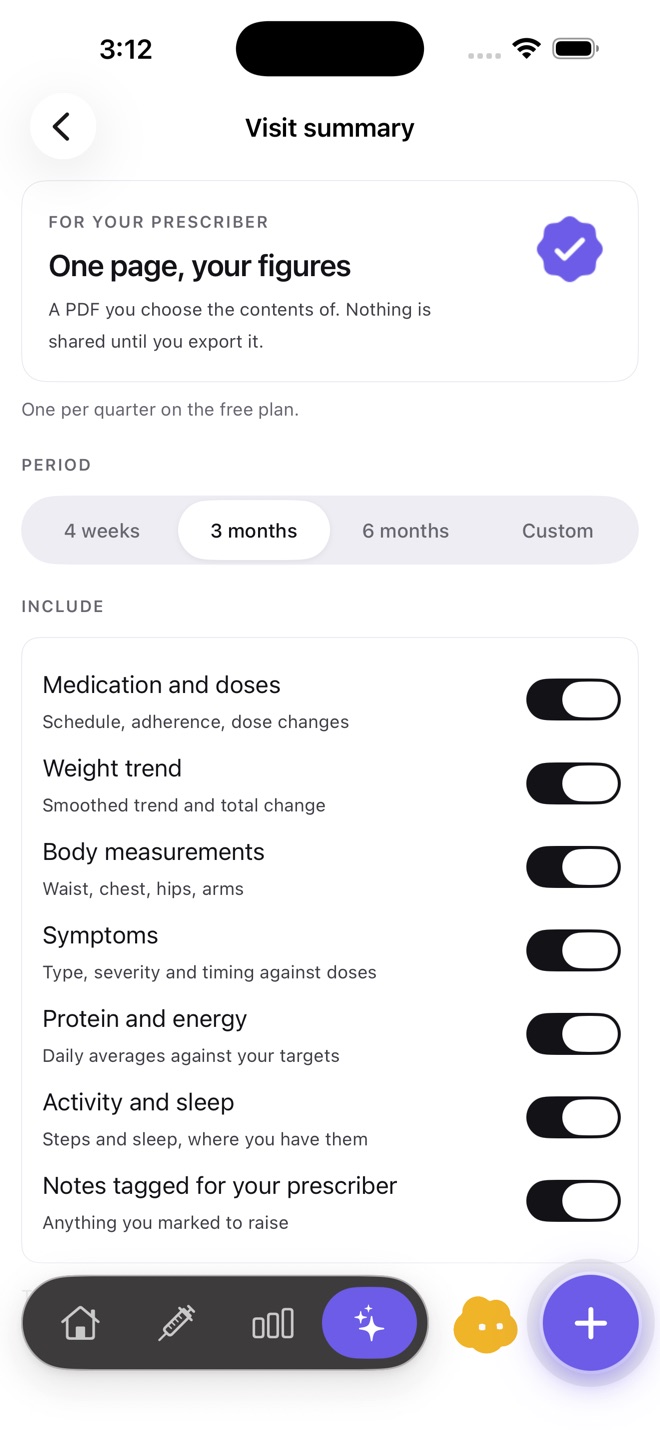
Screenshots: Cafeity for iPhone, version 1.1.
Common questions
What should I write in a GLP-1 symptom diary?
How should I rate side-effect severity?
Should I track symptoms by the day of my dosing week?
When should I call instead of just logging a symptom?
Sources
- Overview of the PRO-CTCAE (patient-reported outcomes version of the Common Terminology Criteria for Adverse Events) National Cancer Institute
- Semaglutide injection and tablets for weight management — US prescribing information DailyMed, US National Library of Medicine, version published 30 June 2026
- Tirzepatide injection for weight management and obstructive sleep apnoea — US prescribing information DailyMed, US National Library of Medicine, version published 2 September 2026
- Nutritional priorities to support GLP-1 therapy for obesity: a joint advisory from the American College of Lifestyle Medicine, the American Society for Nutrition, the Obesity Medicine Association and The Obesity Society Mozaffarian D et al. 2025 (published in four journals)
- MedWatch — report a side effect to the FDA US Food and Drug Administration
- Yellow Card — report a suspected side effect (UK) Medicines and Healthcare products Regulatory Agency
Written by the Cafeity team from the sources listed here. Figures from prescribing information are quoted as the label states them; trial results are averages from those trials, not predictions for any one person. This page has not yet been reviewed by a clinician — see the editorial policy for how pages are researched and corrected.