

Why preparing pays off
The US Agency for Healthcare Research and Quality, which runs the "Questions Are the Answer" campaign, notes that patients who ask questions and make sure they understand the answers tend to get more timely, accurate diagnoses and have better outcomes.1 A GLP-1 follow-up usually covers the same ground each time — side effects, how you are eating, how your weight and health are changing, and whether to continue as you are — so you can prepare evidence for each.
What to bring
- The medicine's name and strength, as printed on the pharmacy label
- A list of every other medicine and supplement you take
- Your dose record: dates taken, late or missed
- Your weight trend since the last visit, not just today's number
- Waist and other measurements, if you take them
- Side effects: what, when, how bad, how long, what helped
- A typical day of eating, with protein and fluids
- Activity and sleep, roughly
- Readings or results from other clinicians (blood pressure, blood tests)
- Insurance details and any prior authorization renewal date
AHRQ suggests bringing every medicine you take, including non-prescription medicines such as antacids, vitamins, and dietary or herbal supplements.1 For side effects, the more specific the better; see tracking symptoms so your doctor can use them.
What to mention
- Anything new in your health or other medicines
- Planned surgery, procedures or sedation
- Pregnancy plans, or birth control pills
- Supply problems: running low, pharmacy stock, cost
- How you are feeling, not only what you weigh
Two of these come straight from the labels. Tell your healthcare providers about any planned surgery or procedure, because a slower-emptying stomach can complicate anaesthesia or deep sedation,2 and raise birth control pills if you take them, since the tirzepatide label says it may make them less effective for a time.3 Supply and cost problems are common too: in KFF's November 2025 poll, 56% of GLP-1 users said the medicines were difficult to afford.4
Your top three questions first
AHRQ's own appointment sheet asks for the top three questions you want to be sure to ask.1 Put them at the top of your list, because time runs out before lists do. Questions that tend to be most useful at a GLP-1 follow-up:
- Is my progress what you would expect by now, and how are you judging it?
- What should I do about the side effect that has not settled?
- Am I eating enough, especially protein? Should I see a dietitian?
- Should I be doing strength training, and how much?
- When will we next review whether to continue, change or stop?
AHRQ's general list adds two worth keeping in mind whenever anything new is prescribed: are there any side effects, and will this medicine interact with medicines I already take?5 There is a longer list in questions to ask your doctor.
During the appointment
Before you leave
- What, if anything, changes from today
- What to do about side effects that do not settle
- Which symptoms mean call straight away, and who to call
- When the next review is, and what will be looked at
- Whether you need blood tests or a referral before then
Afterwards, AHRQ's advice is to call if you don't understand your instructions once you are home, to talk with your doctor or pharmacist before stopping any prescribed medicine, and to call if symptoms get worse.1
If the follow-up is by video or phone
Many GLP-1 follow-ups happen online: in KFF's November 2025 poll, about one in six users (17%) said they got their GLP-1 from an online provider or website.4 For a video visit, have your latest weight and measurements written down, take clear photos of anything visible — an injection-site reaction, say — before the call, check the link works, and find somewhere quiet with good light.
Keeping a record of it
Cafeity's Visit Summary is built for this checklist: choose a period — 4 weeks, 3 months, 6 months or custom — and the sections to include, and it makes one page with your doses, weight trend, measurements, symptoms, nutrition and the notes you tagged for your prescriber.
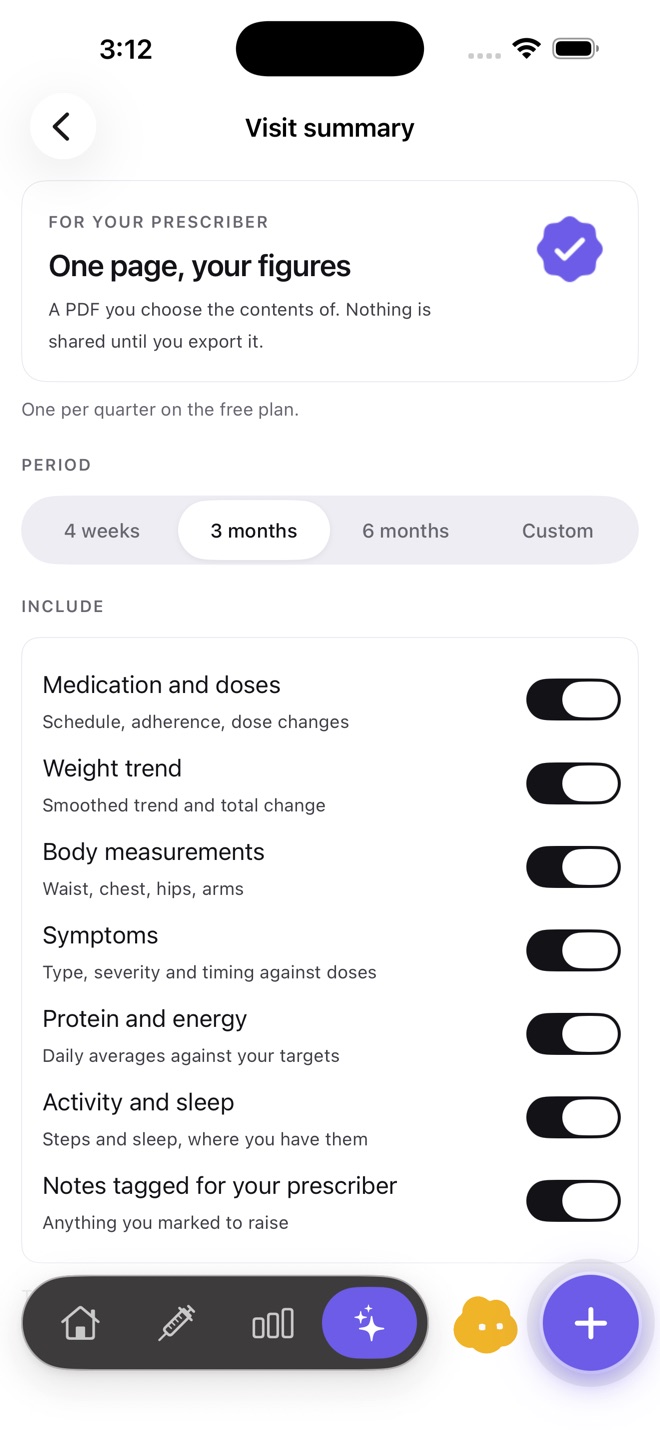
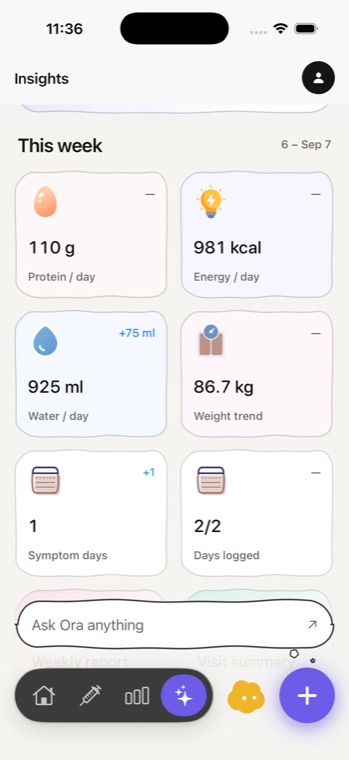
Screenshots: Cafeity for iPhone, version 1.1.
Common questions
What should I bring to a GLP-1 follow-up appointment?
What questions should I ask at a GLP-1 follow-up?
Should I tell my doctor about planned surgery?
What if I forget to ask something?
Is there a printable GLP-1 appointment checklist?
Sources
- Be more engaged in your healthcare: tips for patients Agency for Healthcare Research and Quality, last reviewed November 2024
- Semaglutide injection and tablets for weight management — US prescribing information DailyMed, US National Library of Medicine, version published 30 June 2026
- Tirzepatide injection for weight management and obstructive sleep apnoea — US prescribing information DailyMed, US National Library of Medicine, version published 2 September 2026
- Poll: 1 in 8 adults say they are currently taking a GLP-1 drug for weight loss, diabetes or another condition, even as half say the drugs are difficult to afford KFF Health Tracking Poll (fieldwork 27 October–2 November 2025, 1,350 US adults), 14 November 2025
- The 10 questions you should know Agency for Healthcare Research and Quality
Written by the Cafeity team from the sources listed here. Figures from prescribing information are quoted as the label states them; trial results are averages from those trials, not predictions for any one person. This page has not yet been reviewed by a clinician — see the editorial policy for how pages are researched and corrected.