

Why muscle matters on a GLP-1
Weight lost on any treatment that produces large, fast losses includes some lean mass. The joint advisory cites modelling suggesting that, without structured strength training, muscle makes up about 10–15% of the weight lost by women and 20–25% of the weight lost by men, and notes that low protein intake, older age, menopause, low testosterone and inactivity add to the risk.1 For the body-composition data from the trials, see GLP-1 muscle loss.
That is why the advisory says GLP-1 medicines should come with a structured exercise programme — strength training at least three times a week plus at least 150 minutes of moderate aerobic activity — customised to your fitness and abilities.1 The general US guidelines ask all adults for muscle-strengthening activity at least two days a week.2
The beginner's week
Three strength sessions on non-consecutive days give muscles a day to recover between them. Walks fill the days in between; see walking more on a GLP-1. If three sessions feel like too much at first, start with two and add the third after a few weeks.
Before each session, warm up for five minutes: march on the spot, roll your shoulders, swing your arms, and do a few slow chair squats.
Session A
| Move | How | Easier · harder |
|---|---|---|
| Chair squat | Sit back to touch a chair with your bottom, then stand up tall, 8–12 times | Push off your thighs · lower slowly, hold a backpack |
| Wall push-up | Hands on a wall at shoulder height, step back, lower your chest towards the wall, push back, 8–12 times | Stand closer · use a kitchen counter, then a sturdy table |
| Glute bridge | Lying on your back, knees bent, lift your hips until your body is straight, 10–15 times | Smaller lift · pause at the top, or one leg |
| Backpack row | Lean on a counter with one hand, pull a loaded backpack to your ribs, 8–12 each side | Lighter bag · heavier bag, slower lowering |
| Farmer's carry | Walk with a heavy shopping bag or water jug in each hand, 30–60 seconds | Lighter bags · longer walk, heavier bags |
| Calf raise | Holding the counter, rise onto your toes and lower slowly, 12–15 times | Both feet · one foot at a time |
Session B
| Move | How | Easier · harder |
|---|---|---|
| Step-up | Step onto the bottom stair, stand tall, step down, 8 each leg | Hold the banister · hold a backpack |
| Split squat | One foot forward, one back, holding a chair; lower the back knee towards the floor, 6–10 each leg | Shallower · deeper, slower |
| Counter push-up | Hands on a kitchen counter, body straight, lower and push back, 8–12 times | Back to the wall · lower surface |
| Backpack hinge | Hug a loaded backpack, push your hips back with a flat back, stand up by squeezing your glutes, 10 times | Empty bag · heavier bag |
| Bird dog | On hands and knees, reach one arm and the opposite leg out long, hold for 2 seconds, 8 each side | Arms only · add a pause |
| Plank on knees | Forearms and knees on the floor, body straight from head to knees, 20–30 seconds | Hands on a counter · plank on toes |
How to progress
- Reps first. When you can do the top of the rep range for both sets with good form, add a rep or two.
- Then sets. Move from two sets to three.
- Then load. Add a book or a water bottle to the backpack, or carry heavier bags.
- Keep it hard but tidy. Finish each set feeling you could have managed one or two more good reps. Breathe out as you push or lift.
Write down what you did. Seeing that you went from wall push-ups to counter push-ups is one of the best non-scale wins there is.
Protein, fluids and timing
Training is half of protecting muscle; protein is the other half. The joint advisory gives a practical target of 80 to 120 g of protein a day and suggests eating protein-rich foods first in a meal, since appetite is limited.1 A yoghurt or a glass of milk after a session is an easy start; see high-protein breakfasts and what to eat on a GLP-1.
Drink water around sessions, especially on days with nausea or diarrhoea, which can dehydrate you. If you feel light-headed on standing, slow down; see dizziness.
Starting safely
- If you have a heart or lung condition, joint problems or an injury, or have been told to limit activity, check with your clinician before starting.
- Stop and get help for chest pain or pressure, severe breathlessness, or feeling faint.
- If you take insulin or a sulfonylurea, exercise can lower blood sugar further; the labels already warn of a higher risk of low blood sugar with those medicines, so ask your prescriber how to plan around sessions.34
- Skip a session on a rough side-effect day. Missing one does not undo anything.
Keeping a record of it
Cafeity reads steps, active energy and exercise minutes from Apple Health and shows them on the same timeline as your protein, doses and weight trend, so you can see training alongside everything else.
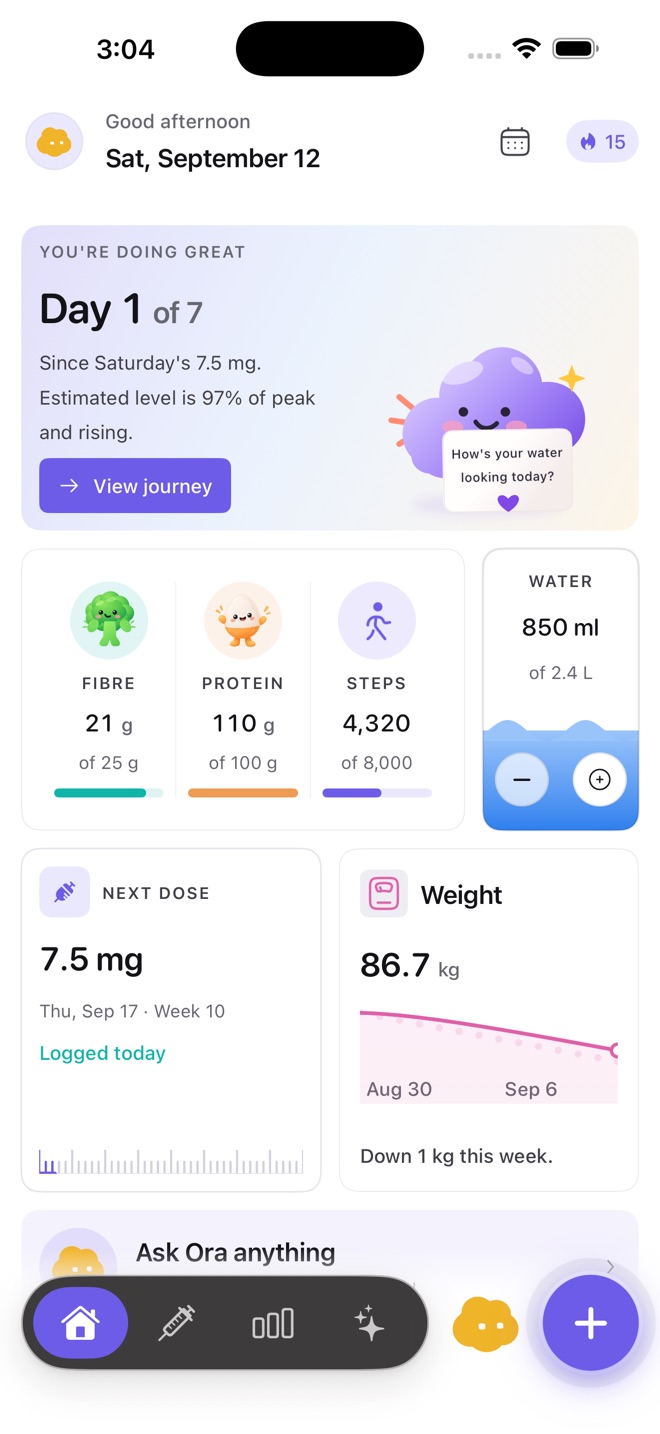

Screenshots: Cafeity for iPhone, version 1.1.
Common questions
Do I need to strength train on a GLP-1?
Can I build strength at home without equipment?
How long should a beginner's strength session be?
How much protein do I need when strength training on a GLP-1?
Should I train on days I feel sick?
Sources
- Nutritional priorities to support GLP-1 therapy for obesity: a joint advisory from the American College of Lifestyle Medicine, the American Society for Nutrition, the Obesity Medicine Association and The Obesity Society Mozaffarian D et al. 2025 (published in four journals)
- Top 10 things to know about the second edition of the Physical Activity Guidelines for Americans Office of Disease Prevention and Health Promotion, US Department of Health and Human Services
- Semaglutide injection and tablets for weight management — US prescribing information DailyMed, US National Library of Medicine, version published 30 June 2026
- Tirzepatide injection for weight management and obstructive sleep apnoea — US prescribing information DailyMed, US National Library of Medicine, version published 2 September 2026
Written by the Cafeity team from the sources listed here. Figures from prescribing information are quoted as the label states them; trial results are averages from those trials, not predictions for any one person. This page has not yet been reviewed by a clinician — see the editorial policy for how pages are researched and corrected.