

Why non-scale victories matter on a GLP-1
Body weight is a noisy measure. It moves with water, salt, what is in your gut and the time of day, which is why a single weigh-in can contradict a week of real change. Non-scale changes build more quietly, and they are easy to forget once they become normal: three months on, it is hard to remember that the stairs used to leave you out of breath.
Keeping track is also a habit with evidence behind it. The 2025 joint advisory on nutrition and GLP-1 therapy lists self-monitoring of body weight, food intake and activity among the behaviours generally associated with keeping weight off over the long term, alongside regular activity, advance planning and support from other people.1 A dated list of wins is a gentle kind of self-monitoring that doesn't revolve around a single number.
None of the wins below is a promise. Bodies and circumstances differ, and some of these may never apply to you. They are things worth noticing if they happen.
The 40 wins
Grouped so you can scan for the ones that fit your life. Tick them on the printable checklist and write the date beside each.
Everyday comfort
- Tying your shoes without holding your breath
- Crossing your legs comfortably
- Getting up off the floor more easily
- An aeroplane or stadium seat with room to spare
- A seatbelt that clicks without a stretch
- Stairs that feel easier on your knees
- Waking up feeling more rested
Clothes and fit
- A ring or watch that slides more freely
- Your belt on a new notch
- Jeans that button without a fight
- Clothes from the back of the wardrobe fitting again
- A shirt that no longer pulls across the buttons
- Enjoying trying clothes on
Movement and energy
- Walking further than last month
- A flight of stairs without stopping
- Playing on the floor with children or grandchildren
- Finishing a workout that felt impossible at the start
- Carrying the shopping in one trip
- Keeping pace on a walk with a friend
- Saying yes to a hike, a dance or a ride you used to avoid
Food and headspace
- Leaving food on the plate without guilt
- Quieter food noise
- Noticing when you are full — and stopping
- Reaching for protein first without thinking about it
- Enough water on most days
- Enjoying a meal without planning the next one
- A small treat, enjoyed and finished, with no spiral
Numbers to ask your clinician about
- Your blood pressure at appointments
- HbA1c or blood sugar results, if you have them checked
- Cholesterol results
- Your waist measurement
- Resting heart rate, if your watch tracks it
These are measured at appointments, not promised by any medicine. Ask your clinician what your own results mean. For the tape measure, see how to measure your waist.
Life and confidence
- Being in the photo instead of taking it
- Going swimming or to the beach
- Going to an event you would once have skipped
- Keeping your routine through a hard week
- Asking your prescriber the question you had been putting off
- Logging for a whole month
- Saying "no thanks" without explaining
- Feeling like yourself on a bad day
How to record a win so it means something later
"Felt better this week" is hard to use three months later. A specific, dated note is not. A good entry has three parts:
- The date. It turns a feeling into a timeline.
- The specific moment. "Walked to the station without stopping, 12 minutes" beats "more energy".
- A little context. How long you have been on treatment, what changed recently, how you felt that day.
Then look back once a month. Pair the list with progress photos and tape measurements, which show change in shape that the scale averages away. Before an appointment, pick two or three wins to mention: they describe how treatment is going in your own words, which a weight figure alone cannot.
When the scale stalls
Weight loss on these medicines is rarely a straight line, and stretches where the scale barely moves are common. The trial curves flatten over time, and day-to-day noise can hide a slow trend for weeks; see what the trials show about plateaus. A wins list is useful precisely then: it shows what is still changing.
Look at your weight as a trend rather than a daily verdict, check the tape measure every few weeks, and if the scale has not moved for a long time or something else worries you, raise it with your prescriber rather than changing anything on your own.
Wins that have nothing to do with your body
Some of the most important items on the list are not about size at all: keeping a routine through a hard week, asking the question you had been putting off, saying "no thanks" without explaining. They count just as much.
Other people's comments can complicate things. Remarks about weight, even admiring ones, can sting, and a 2020 international consensus statement describes weight stigma as widespread and harmful to health.2 Your list is yours. It does not need anyone else to notice, approve or agree.
Keeping a record of it
Cafeity shows weight as a smoothed trend rather than a daily verdict, and you can hide the numbers and see only the direction. Notes, including your wins, can be tagged for the Visit Summary you take to an appointment.

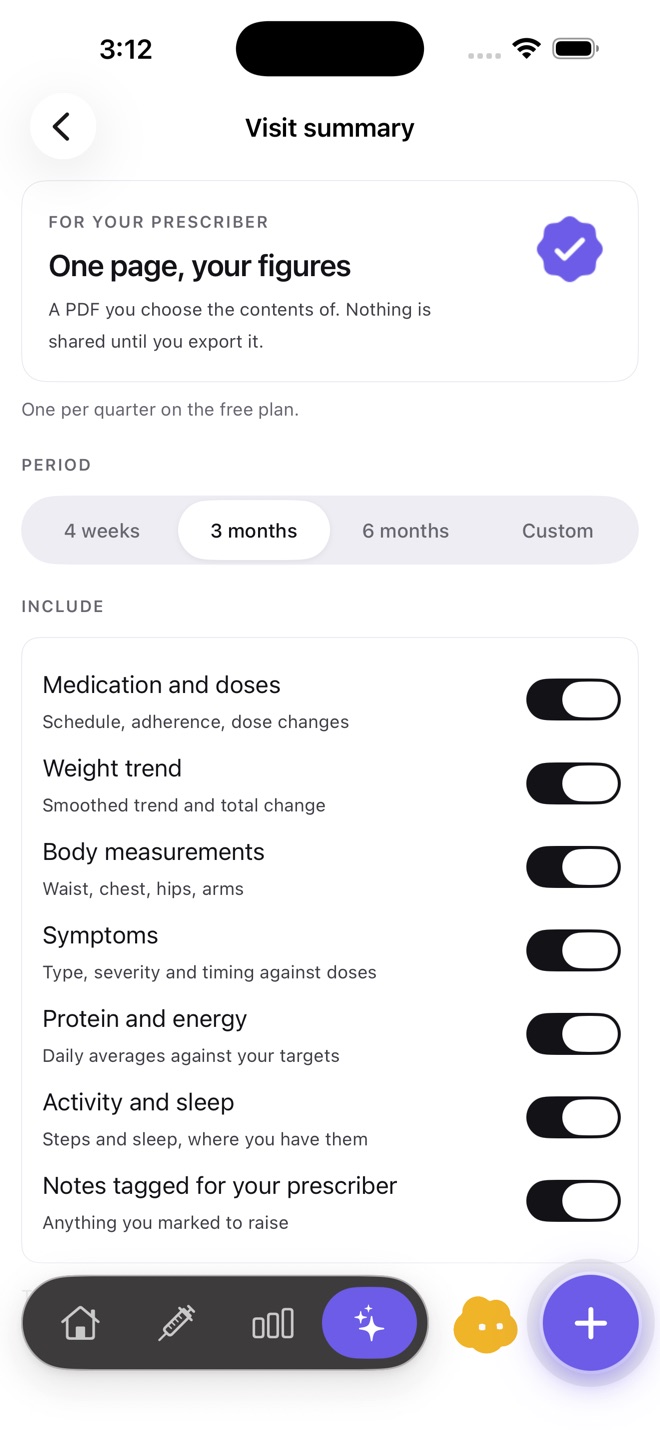
Screenshots: Cafeity for iPhone, version 1.1.
Common questions
What is a non-scale victory?
What are examples of non-scale victories on a GLP-1?
Why do my clothes fit better when the scale has not moved?
How often should I review my wins?
Is there a printable non-scale victory checklist?
Sources
- Nutritional priorities to support GLP-1 therapy for obesity: a joint advisory from the American College of Lifestyle Medicine, the American Society for Nutrition, the Obesity Medicine Association and The Obesity Society Mozaffarian D et al. 2025 (published in four journals)
- Joint international consensus statement for ending stigma of obesity Rubino F et al. Nature Medicine 2020;26:485–497
Written by the Cafeity team from the sources listed here. Figures from prescribing information are quoted as the label states them; trial results are averages from those trials, not predictions for any one person. This page has not yet been reviewed by a clinician — see the editorial policy for how pages are researched and corrected.