

Why measure on a GLP-1
Body weight mixes everything together — fat, muscle, water, the contents of your gut — and it swings from day to day. Circumferences change more slowly and show where change is happening. Clothes fitting differently is often the first thing people notice, and a tape measure puts a number on it.
Waist size also matters for health. The US National Heart, Lung, and Blood Institute notes that carrying most fat around the waist rather than the hips raises the risk of heart disease and type 2 diabetes, and that a waist of more than 35 inches (89 cm) for women or more than 40 inches (102 cm) for men increases risk.2 Your clinician can tell you what your own number means; the point here is to measure it the same way each time so a change is real.
What you need
- A flexible tape measure that does not stretch. The WHO protocol specifies a stretch-resistant tape.1 Fabric tapes can stretch with age; fibreglass tapes hold their length.
- A mirror, or someone to help, to check the tape is level at the back.
- The log — the free printable on this page, a notebook, or an app.
- Five minutes, at the same time of day each time.
The method, step by step
- Measure in the morning, before eating. The WHO expert report notes that food, water and gas in the gut all affect the waist reading.1
- Wear little or nothing over the area. Measure on skin, or over the same thin layer every time.
- Stand relaxed, feet close together, arms at your sides, weight evenly on both feet.1
- Find the landmarks with your fingers: the bottom of your lowest rib at the side, and the top of your hip bone.
- Wrap the tape level with the floor, and check the back in a mirror.
- Snug, not tight. The tape should touch the skin all the way round without pressing in.
- Breathe normally and read the tape at the end of a normal breath out. Don't hold your breath or pull your stomach in.1
- Measure twice. If the two readings are within 1 cm of each other, record the average; if not, take two more.1
Where to measure, site by site
| Site | Where the tape goes | Watch out for |
|---|---|---|
| Waist | Halfway between your lowest rib and the top of your hip bone1 | Pulling your stomach in; the tape slipping down at the back |
| Hips | Around the widest part of your buttocks, parallel to the floor1 | Feet apart, which changes the reading |
| Chest | Under the armpits, across the fullest part of the chest and the shoulder blades | Holding your breath; a padded bra one time and not the next |
| Neck | Just below the Adam's apple, level all the way round | Pulling tight |
| Upper arm | Halfway between the tip of the shoulder and the elbow, arm relaxed at your side | Flexing the muscle |
| Thigh | A fixed distance above the top of the kneecap, such as 15 cm (6 in), standing | "The widest bit", which moves as your shape changes |
Why there are different waist methods
Not every guideline puts the waist in the same place. The WHO protocol uses the midpoint between the lowest rib and the top of the hip bone; the US National Institutes of Health method places the tape just above the hip bones; some research studies measure at the navel.12 A review discussed in the WHO report found that the choice of site made little difference to how waist size related to heart disease, diabetes and death.1
For tracking your own progress, the method matters less than using the same one every time. Pick a site, write it on your log, and don't switch.
How often to measure, and what counts as a change
Every two to four weeks is plenty. Weekly measurements mostly record noise.
Even careful measurers vary. The WHO report cites a technical error — a measure of how much repeat readings scatter — of about 1.3 cm for waist measurements taken by the same person, and about 1.6 cm between different people, from studies in adolescents.1 So treat a change of a centimetre or so as within the margin of error, and look for a direction across three or four measurements. Some people also notice bloating at particular points in their menstrual cycle; a note in the log explains an odd reading later.
Recording it
The free log on this page has the six sites, a column for weight, and room for notes, with the method printed at the top. Download it above in US Letter or A4.

If you would rather the record kept itself, Cafeity logs waist, hips, chest, arm, thigh and neck alongside your weight, can read waist measurements from Apple Health, and can include measurements in the Visit Summary.
Keeping a record of it
Add measurements when you log your weight in Cafeity: six sites, the same every time, on the same timeline as your doses and symptoms.

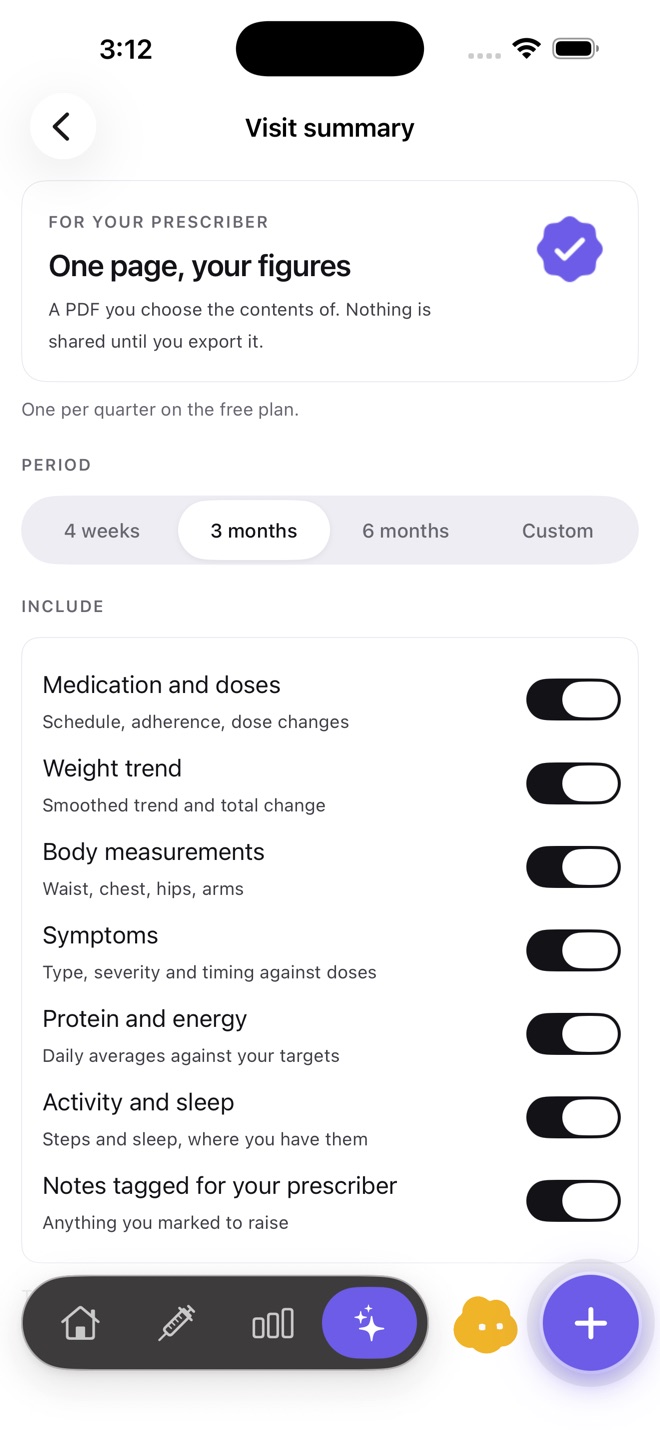
Screenshots: Cafeity for iPhone, version 1.1.
Common questions
Where exactly is my waist for measuring?
Should I measure before or after eating?
What waist size increases health risk?
How often should I measure on a GLP-1?
How tight should the tape be?
Is there a free body measurement template?
Sources
- Waist circumference and waist–hip ratio: report of a WHO expert consultation, Geneva, 8–11 December 2008 World Health Organization (2011)
- Aim for a healthy weight — measuring waist circumference National Heart, Lung, and Blood Institute, US National Institutes of Health
Written by the Cafeity team from the sources listed here. Figures from prescribing information are quoted as the label states them; trial results are averages from those trials, not predictions for any one person. This page has not yet been reviewed by a clinician — see the editorial policy for how pages are researched and corrected.