

How to use these prompts
- One prompt, five minutes. Set a timer, write without stopping, and don't edit.
- Paper or phone. Whatever you will actually use. Paper is harder to scroll past; a phone is always with you.
- Pick by the day you're having. Use the hard-day prompts when you need them, not in order.
- Keep it private. Writing for nobody else makes it easier to be honest.
- Read back once a week. Patterns — around your dose day, your sleep, your stress — show up across entries, not within one.
Prompts for the hard days
- What is the hardest part of today, in one sentence?
- What does my body need right now: food, water, rest, movement or quiet?
- If today's worst symptom had a volume from 0 to 10, where is it — and what nudged it up or down?
- What have I eaten and drunk in the last six hours? Is anything missing?
- What would I say to a friend who felt like this today?
- Which side effect bothers me most, and is it new, easing or getting worse?
- Is anything today a reason to call my prescriber?
- What is one small thing I can do in the next hour that later-me will thank me for?
- Who could I tell how today is really going?
- What has helped on a day like this before?
For prompt 7, the warning signs worth acting on are listed in GLP-1 side effects and at the foot of this page.
Prompts for the good days
- What went well today, and what made it possible?
- What did my body let me do today that it could not before?
- Which meal today left me feeling best afterwards?
- What am I proud of this week that has nothing to do with the scale?
- When did I feel most like myself today?
- Which habit felt easier this week than last?
- What kind moment or compliment do I want to remember?
- What would I like to try now that I would not have before?
- Which non-scale win can I add to my list today?
- What do I want to remember about this point in my journey?
Prompts for looking back and ahead
- How is my appetite this week compared with last week?
- How loud was food noise this week, and when was it loudest?
- What patterns do I notice around my dose day?
- Where does most of my protein come from, and what would be easy to add?
- How did I sleep this week, and how did it shape the next day?
- What do I want to ask at my next appointment?
- What is working that I want to keep, whatever the scale says?
- What is one thing I would change about next week?
- How do I feel about my body today, in words that are not numbers?
- Why did I start, and is that still my reason?
What the research says about writing it down
Writing about thoughts and feelings — "expressive writing" in the research — has been studied for decades. The largest meta-analysis, which pooled 146 randomised studies, found a positive and statistically significant effect on average, but a small one, with results varying by who was writing and how.1 That is a fair way to think about a journal: a modest, low-cost habit that helps some people more than others.
Stress and eating are closely linked, and the 2025 joint nutrition advisory on GLP-1 therapy notes that mindfulness may help people cope with the medicines' side effects, and that referral for cognitive-behavioural therapy or mindfulness-based stress reduction may be considered.2 A journal is not a substitute for either, but it can help you notice when you might want one.
Turning entries into something useful
A few habits turn a private journal into a record you can act on:
- Note the day of your dosing week beside each entry. Side effects and appetite often follow the cycle; see when side effects start and how long they last.
- Rate food noise from 0 to 10 on the days it is loud; see food noise.
- Underline anything for your prescriber and copy it into your follow-up checklist.
If you prefer the patterns found for you, Cafeity's daily check-ins record appetite, mood, energy and sleep in your own words, notes can be tagged for the Visit Summary, and Cafeity Pro looks for patterns in your own log.
If a hard day is more than a hard day
Keeping a record of it
Cafeity keeps the structured part of a journal for you: mood, energy, appetite, sleep and food noise on the same timeline as your doses, with free-text notes you can tag for your prescriber.

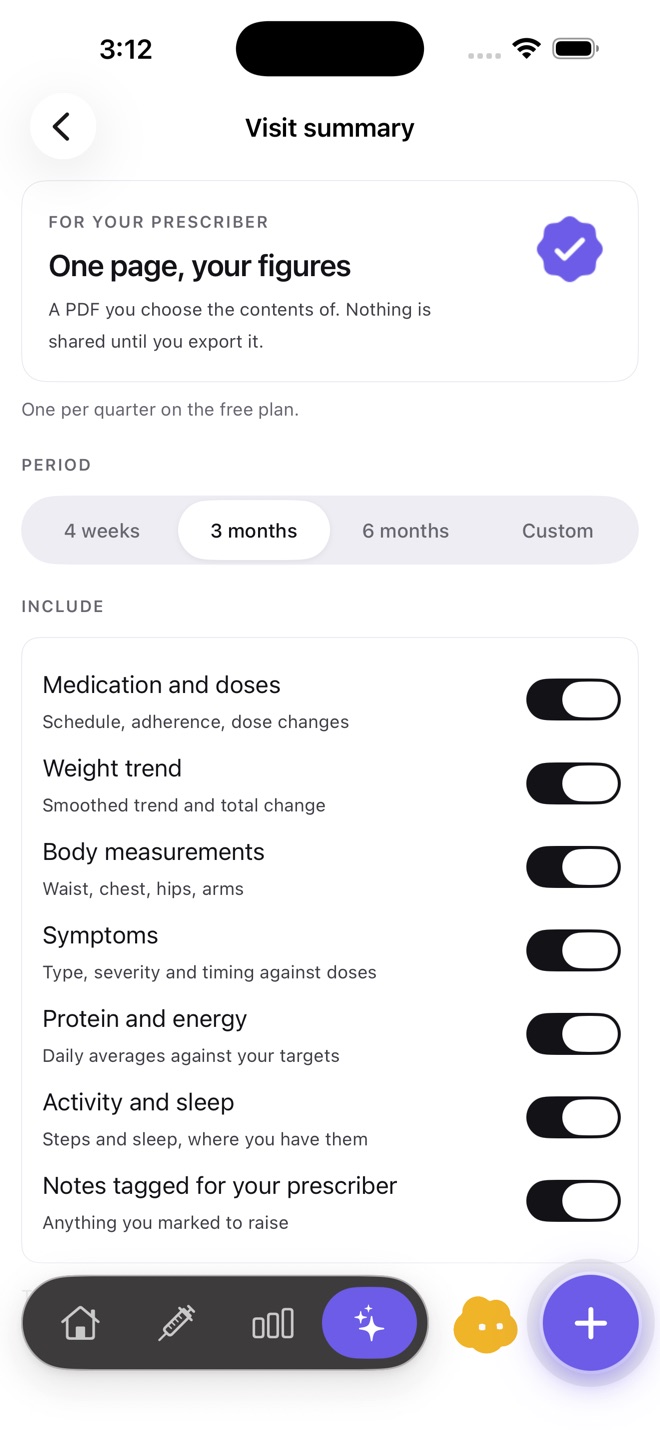
Screenshots: Cafeity for iPhone, version 1.1.
Common questions
What should I write in a GLP-1 journal?
How often should I journal?
Does journaling actually help?
Should I write my weight in my journal?
Is there a printable version of these prompts?
Sources
- Experimental disclosure and its moderators: a meta-analysis Frattaroli J. Psychological Bulletin 2006;132(6):823–865
- Nutritional priorities to support GLP-1 therapy for obesity: a joint advisory from the American College of Lifestyle Medicine, the American Society for Nutrition, the Obesity Medicine Association and The Obesity Society Mozaffarian D et al. 2025 (published in four journals)
Written by the Cafeity team from the sources listed here. Figures from prescribing information are quoted as the label states them; trial results are averages from those trials, not predictions for any one person. This page has not yet been reviewed by a clinician — see the editorial policy for how pages are researched and corrected.