

Deciding whether to tell
There is no right answer, only the one that suits your life. A few questions help:
- Who needs to know for practical reasons? People who share your meals, someone who would help if you felt unwell, a travelling companion if you carry your medicine (see travelling with a GLP-1).
- Whose support would you like? Telling one or two people who will be kind is often worth more than telling everyone.
- Who is likely to react badly? You don't owe them the information, or a debate about it.
- What would you share? "I'm on a medicine that makes me full quickly" is a complete answer. The name, the reason and anything about your dose can stay private.
One group always needs to know: the clinicians who treat you. The semaglutide label asks patients to tell their healthcare providers before any planned surgery or procedure, because a slower-emptying stomach can complicate anaesthesia or deep sedation.3 That includes dentists and anyone giving sedation.
You are far from the only one
It can feel like a confession. It isn't. In KFF's November 2025 poll of 1,350 US adults, 12% said they were currently taking a GLP-1 drug and 18% said they had taken one at some point. About four in ten (37%) said a close friend or family member was using one.2
The same poll found that most users take these medicines for more than weight: 38% said they took them mainly for a chronic condition such as diabetes or heart disease, 32% for both a condition and weight loss, and 30% mainly to lose weight.2 Whatever your reason, it is a prescription between you and your clinician.
At work
You generally don't have to tell your employer. Under the Americans with Disabilities Act, an employer may ask disability-related questions of employees only when they are job-related and consistent with business necessity. The EEOC's guidance says that asking all employees about their prescription medicines generally does not meet that standard, with narrow exceptions for some public-safety jobs. Any medical information you do share, even voluntarily, must be kept as a confidential medical record.1 Rules differ outside the US.
If side effects affect your work — a rough morning after a dose, say — you can ask for an adjustment without naming the medicine. See working through nausea days.
| When | You could say |
|---|---|
| A colleague asks about your weight | "Thanks, I'm feeling good." Then move on to the meeting. |
| Someone asks directly if you're "on one of those" | "I keep health stuff private at work, but thanks for asking." |
| The team orders lunch | "I'll grab something small. I'm not very hungry today." |
| Your manager notices you're off-colour | "I'm dealing with a health thing that's settling down. Could I take the 9 am call from home tomorrow?" |
With family
Families are where food and bodies get discussed most freely, so it helps to decide in advance how much you want to say. If you tell them, say what you would like from them as well as what you are doing:
- "My doctor and I have started me on a medicine that makes me full quickly. I'm going to eat smaller portions — please don't take it personally."
- "I'm happy to talk about it, but not at the dinner table."
- "The most helpful thing would be not commenting on my plate."
If someone calls it "the easy way out", you can point out — or simply know — that a 2020 international consensus statement on weight stigma concluded that body weight is not entirely under voluntary control, and that biological, genetic and environmental factors play a critical part.4 Medicine for a medical condition is not cheating.
With friends
Friends mostly notice the practical changes: you eat less when you go out, you drink less, you leave food on the plate. A light, honest line usually ends it: "I'm on a medicine that fills me up fast, so I'll share a starter." If friends ask how it works or whether it would suit them, describe your own experience and point them to their own clinician — what suits one person's health may not suit another's.
For meals out, see eating out on a GLP-1; for nights out, alcohol on a GLP-1.
Telling people online
Posting about treatment can bring support, and it is permanent. Before you share, think about who can see it now and later — employers, relatives, future partners. Communities for people on GLP-1 medicines can be useful for experiences and tips; take any advice about doses or switching medicines back to your prescriber rather than acting on it.
Keeping a record of it
Cafeity never sells your health data or uses it for advertising or tracking, and a Visit Summary only goes to someone when you export it and choose who gets it.
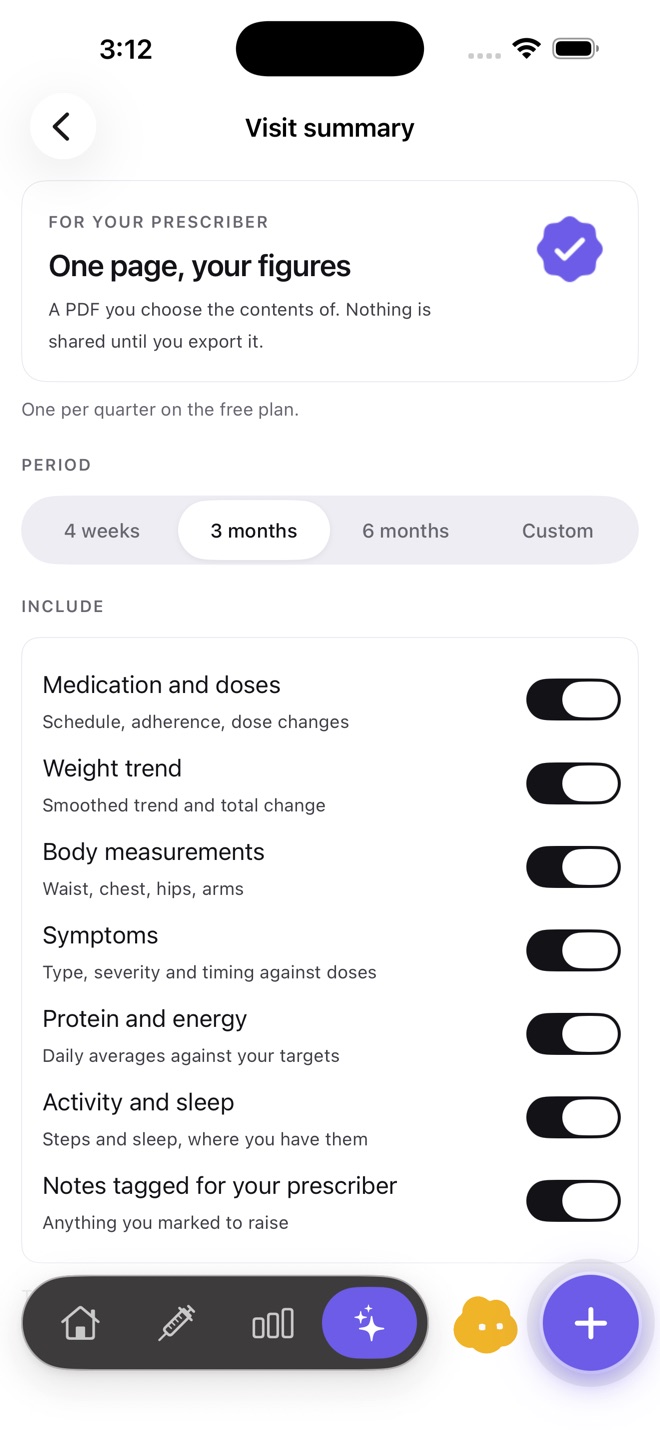
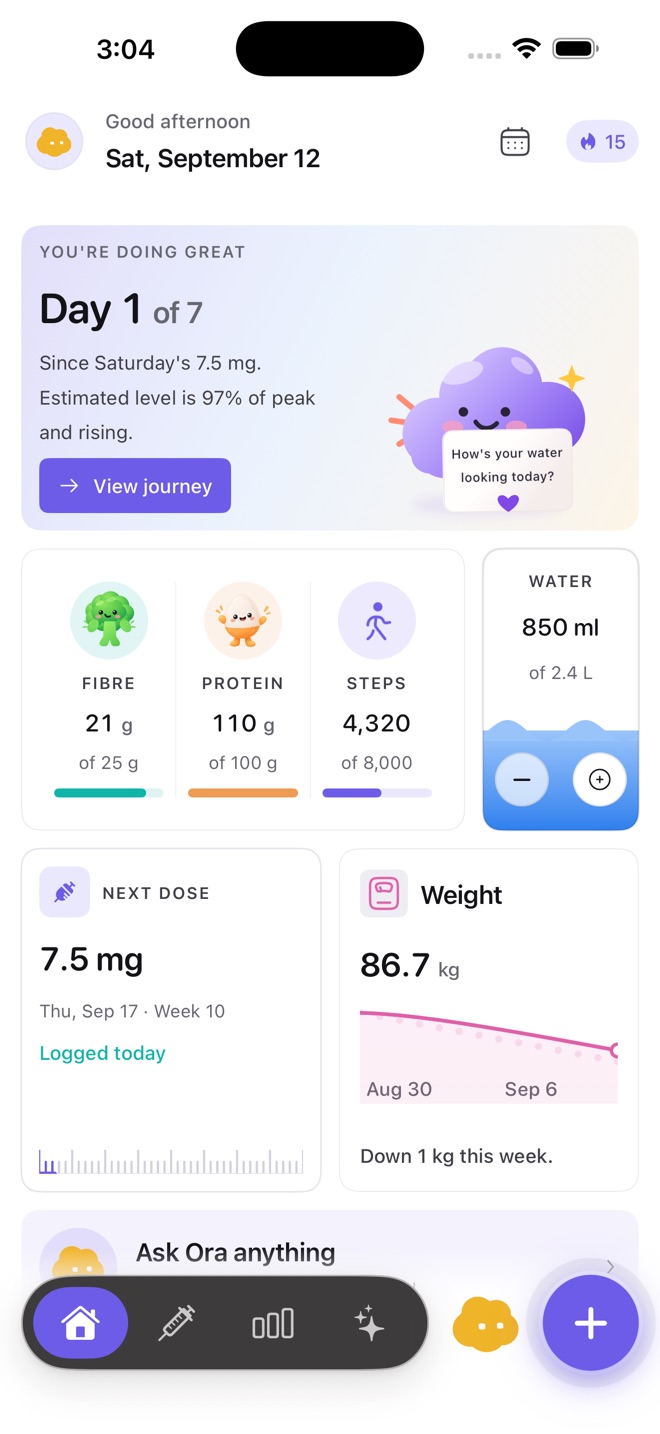
Screenshots: Cafeity for iPhone, version 1.1.
Common questions
Do I have to tell my employer I'm on a GLP-1?
Can my employer ask what medicines I take?
How common is it to be on a GLP-1?
What do I say when someone calls it the easy way out?
Should I tell my dentist or surgeon?
Sources
- Enforcement guidance on disability-related inquiries and medical examinations of employees under the Americans with Disabilities Act US Equal Employment Opportunity Commission
- Poll: 1 in 8 adults say they are currently taking a GLP-1 drug for weight loss, diabetes or another condition, even as half say the drugs are difficult to afford KFF Health Tracking Poll (fieldwork 27 October–2 November 2025, 1,350 US adults), 14 November 2025
- Semaglutide injection and tablets for weight management — US prescribing information DailyMed, US National Library of Medicine, version published 30 June 2026
- Joint international consensus statement for ending stigma of obesity Rubino F et al. Nature Medicine 2020;26:485–497
Written by the Cafeity team from the sources listed here. Figures from prescribing information are quoted as the label states them; trial results are averages from those trials, not predictions for any one person. This page has not yet been reviewed by a clinician — see the editorial policy for how pages are researched and corrected.
When people comment anyway
Weight stigma is common and can cause physical and psychological harm, according to the 2020 consensus statement, so it is reasonable to set limits on these conversations.4