

What the research says about steps
The 10,000-steps target is famous, but the evidence behind it is thin — a point made by the authors of the largest analysis of steps and survival.2 That meta-analysis pooled 15 studies of 47,471 adults followed for a median of 7.1 years. Compared with the quarter who took the fewest steps (a median of about 3,550 a day), the risk of death was 40% lower in the next quarter (about 5,800 steps), 45% lower in the third (about 7,800) and 53% lower in the most active (about 10,900), after adjusting for other factors.2
The benefit levelled off at about 6,000–8,000 steps a day for adults aged 60 and over, and 8,000–10,000 for younger adults.2 These are observational associations — active people differ in many ways — but the shape is encouraging: the largest gain comes from moving out of the least active group, not from hitting a big number.
How much, and how fast
The US Physical Activity Guidelines ask adults for at least 150 to 300 minutes a week of moderate-intensity aerobic activity such as brisk walking, and stress that any amount of activity has some health benefits.1 Brisk means you can talk but not sing.
For people on a GLP-1, the 2025 joint advisory pairs at least 150 minutes of moderate aerobic activity a week with strength training at least three times a week.3 It also lists regular physical activity of 60 minutes or more a day among the behaviours generally associated with keeping weight off over the long term.3 Treat that as somewhere to head, not a starting point.
Building the habit
Habits form through repetition in a consistent context. In a study of 96 volunteers who repeated a daily behaviour in the same situation — "after breakfast", for example — the time it took for the behaviour to become automatic ranged from 18 to 254 days, and missing a single day did not materially affect the process.4 A 2026 meta-analysis found that consistency of timing and routine in particular was linked to more physical activity and stronger habits.5
- Attach it to something you already do: after breakfast, at lunch, after dinner, after the school run.
- Start smaller than feels useful — ten minutes — and add five minutes a week.
- Remove friction: shoes by the door, a jacket on the hook, a route already decided.
- Plan for bad weather: a mall, a museum, stairs at home, a treadmill.
- Watch the weekly trend, not the daily count. One missed day changes nothing.
Short walks count
You do not need one long walk. The US guidelines' first message for adults is to move more and sit less.1 A 2025 international consensus on "short bouts of accumulated exercise" — sessions of 10 minutes or less, done at least twice a day — found that using them to break up long periods of sitting reduces the short-term harms of sitting on more than ten markers of metabolic and cardiovascular health.6 Three ten-minute walks a day add up to more than the weekly minimum.
Walking on low-energy and nausea days
Fatigue and nausea are among the common side effects, especially early on and after changes to treatment; see fatigue and nausea. On those days:
Making progress without overdoing it
| Lever | How to add it |
|---|---|
| Time | Add five minutes to one or two walks a week |
| Pace | Walk briskly for a minute, easily for two, and repeat |
| Hills and stairs | Choose a route with a slope, or climb stairs at the end |
| One longer walk | A weekend walk of 45–60 minutes, with company |
| Load | A light backpack on part of the walk |
Comfortable shoes matter more than technical gear. Pair walking with the beginner's strength week: walking does not protect muscle the way strength training does.
Keeping a record of it
Cafeity reads your steps from Apple Health, so walks appear on the Today screen next to your protein, water and dose without any extra logging — and the weekly view shows the trend rather than a single day.
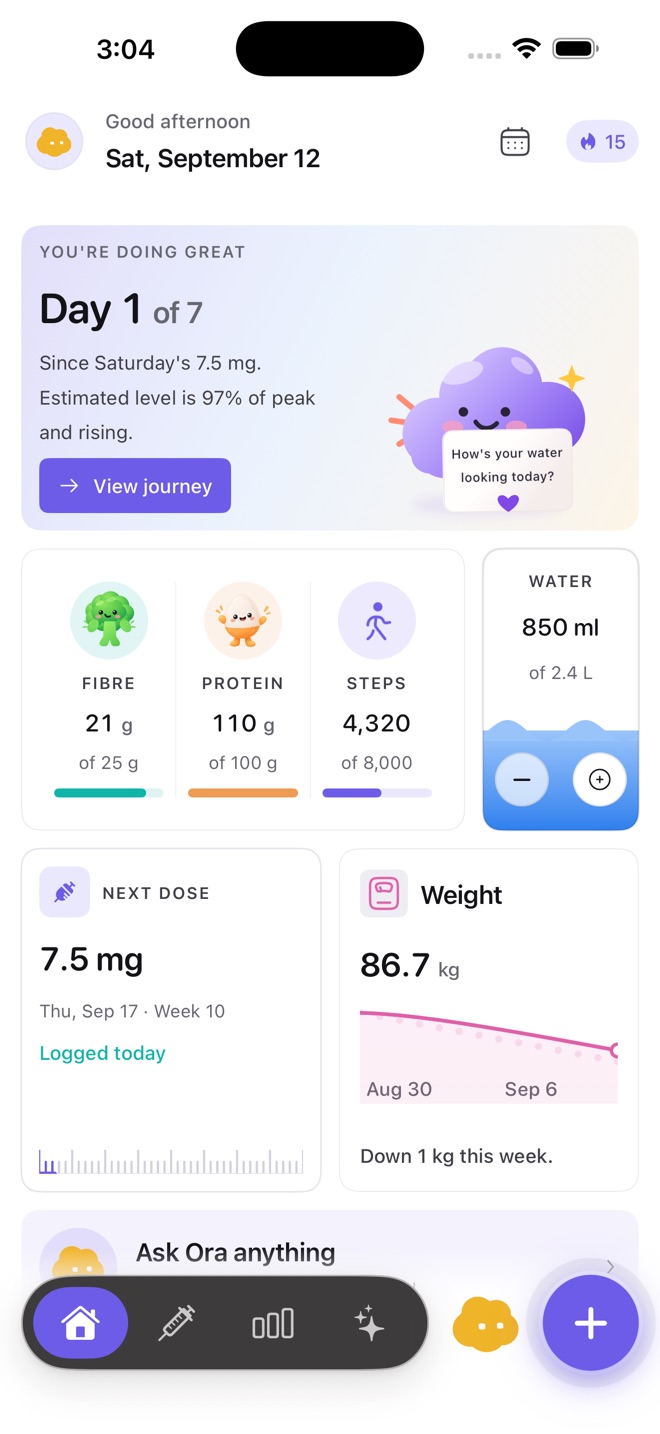
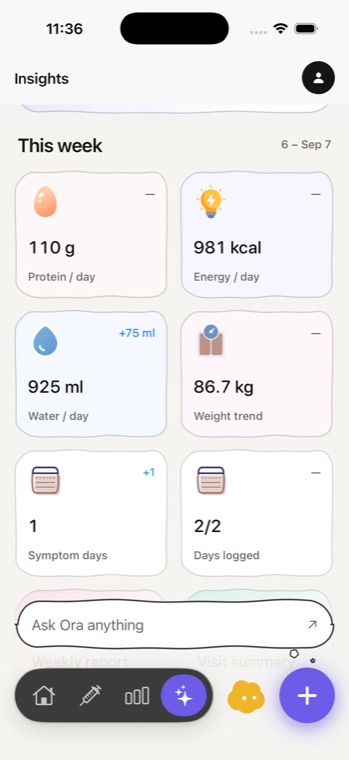
Screenshots: Cafeity for iPhone, version 1.1.
Common questions
How many steps a day should I aim for on a GLP-1?
Is walking enough exercise on a GLP-1?
How long does it take for walking to become a habit?
Do short walks count?
Is 10,000 steps a day necessary?
Sources
- Top 10 things to know about the second edition of the Physical Activity Guidelines for Americans Office of Disease Prevention and Health Promotion, US Department of Health and Human Services
- Daily steps and all-cause mortality: a meta-analysis of 15 international cohorts Paluch AE et al. Lancet Public Health 2022;7(3):e219–e228
- Nutritional priorities to support GLP-1 therapy for obesity: a joint advisory from the American College of Lifestyle Medicine, the American Society for Nutrition, the Obesity Medicine Association and The Obesity Society Mozaffarian D et al. 2025 (published in four journals)
- How are habits formed: modelling habit formation in the real world Lally P, van Jaarsveld CHM, Potts HWW, Wardle J. European Journal of Social Psychology 2010;40(6):998–1009
- Not all cues are equal: a systematic review and three-level meta-analysis of context consistency, physical activity and habit strength Zhu L et al. Applied Psychology: Health and Well-Being 2026;18:e70204
- Short bouts of accumulated exercise: review and consensus statement on definition, efficacy, feasibility, practical applications, and future directions Yin M et al. Journal of Sport and Health Science 2025
Written by the Cafeity team from the sources listed here. Figures from prescribing information are quoted as the label states them; trial results are averages from those trials, not predictions for any one person. This page has not yet been reviewed by a clinician — see the editorial policy for how pages are researched and corrected.