
Protein shakes on a GLP-1: a guide for low-appetite days
Protein shakes can be a convenient way to get protein on days when meals are hard to finish. They do not cause weight loss by themselves, and they are not a replacement for the foods your care team recommends. Read the label for protein, added sugars, and serving size. Ask your prescriber or a registered dietitian what fits you.
Disclosure: Cafeity is made by the author.
Are protein shakes good for weight loss?
A shake does not cause it by itself. The Dietary Guidelines for Americans, 2025–2030, tell people to "prioritize nutrient-dense foods and home-prepared meals". A shake is one food among the rest of what you eat, and what fits you is a question for your prescriber or a registered dietitian.
When a shake can help on a low-appetite day
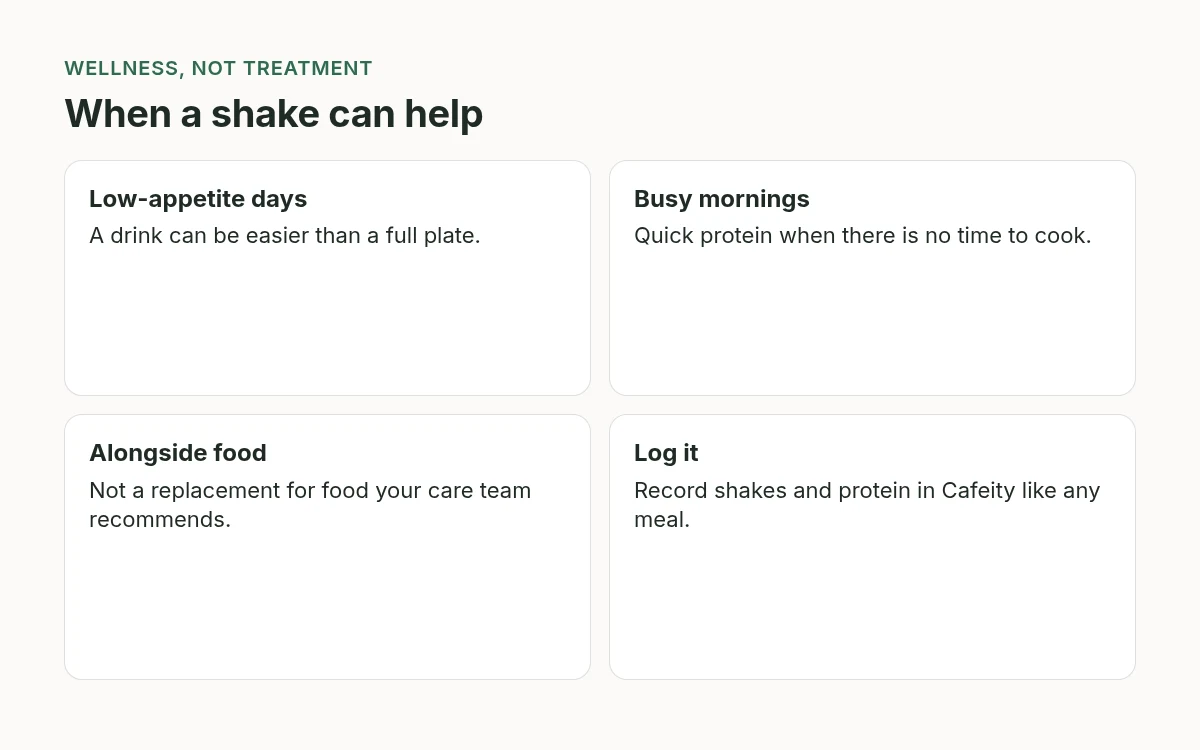
A shake can be easier than a plate on some days: when your appetite is small, when a morning is rushed, or when you can't finish a meal. It is one food you can log. It is not a plan.
For other ways to eat when food doesn't appeal, read eating with no appetite.
How to read the label
Three lines, in this order:
- Protein, in grams. That is the amount in one labeled serving. There is no single amount that "a protein shake" contains, so read the container in your hand.
- Added sugars. On the FDA's definition, added sugars include sugars added during processing (such as sucrose or dextrose), sugars sold as sweeteners (such as table sugar), sugars from syrups and honey, and sugars from concentrated fruit or vegetable juices. They don't include the sugars that occur naturally in milk, fruits and vegetables.
- Serving size. Every figure on the panel is for that serving. Log the amount you actually drank, which may be less than the labeled serving.
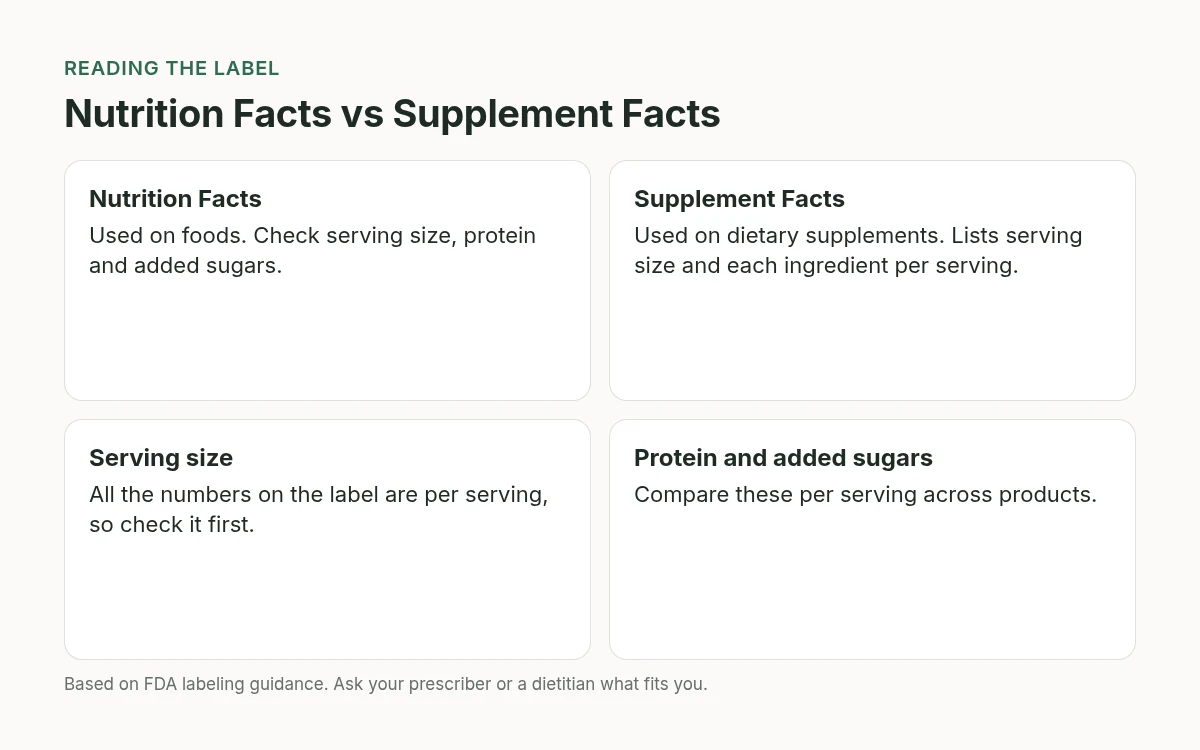
Nutrition Facts or Supplement Facts. The panel title tells you which rules apply. Nutrition Facts is the food label. Supplement Facts is the dietary-supplement label. Under the current federal rule for Supplement Facts (21 CFR 101.36), a nutrient that is absent, or that can be declared as zero, is not listed. A Nutrition Facts panel lists its required nutrients either way. Read protein, added sugars and serving size on whichever panel your container has.
Percent Daily Value. Daily Values are the FDA's reference amounts for reading labels. The reference amount for protein is 50 g, and for added sugars it is 50 g, based on the FDA's 2,000-calorie label example. The %DV column shows how much one serving contributes to that reference. As a general guide for reading a label, 5% DV or less of a nutrient per serving is low and 20% DV or more is high. These are label reference amounts, not targets for you.
Shakes and whole-food protein
A shake's protein is whatever its own label lists. For comparison, two foods from USDA FoodData Central:
- Plain nonfat Greek yogurt (FDC 330137): 10.3 g protein and 61 kcal per 100 g. The 156 g portion stored on that record is 16.1 g protein and 95 kcal.
- One large raw egg white (FDC 172183, 33 g): 3.6 g protein and 17 kcal.
More options are on the printable protein food list. See also high-protein breakfasts, protein on a budget and high-volume, low-calorie foods.
Make it easier to drink
Some people find a shake easier to finish in smaller pours, colder, or next to a few bites of a food they already tolerate. These are preferences, not remedies. Notice what works for you and write it down.
Log the shake in Cafeity
Enter the shake in food logging and the protein tracker, using the grams from the label for the amount you drank. Cafeity keeps the record. It doesn't grade the shake or set a protein goal.
Cafeity is on the App Store for iPhone. There is no Android version yet.
Questions for your care team
- Is a shake appropriate for me?
- How should it sit next to the rest of what I eat?
- Which numbers on the label matter for me?
For a longer list, see questions to ask your doctor. For background on protein and muscle, read muscle loss on a GLP-1.
Common questions
Are protein shakes good for weight loss?
A protein shake does not cause weight loss by itself. It is one way to consume protein when a meal is hard to finish. Whether it fits you is a question for your prescriber or a registered dietitian.
Can I drink protein shakes on a GLP-1?
Ask your prescriber or a registered dietitian. This page can show you how to read a label and how to log what you drink. It cannot tell you that a shake is right for you.
How much protein is in a protein shake?
There is no single amount. Read the protein grams on that container's Nutrition Facts or Supplement Facts panel, for the serving printed there, and log the amount you actually drank. A labeled serving is not a recommendation to finish the container.
What is the difference between Nutrition Facts and Supplement Facts on a shake?
The panel title tells you which rules apply. Nutrition Facts is the food label. Supplement Facts is the dietary-supplement label. On a Supplement Facts panel, a nutrient that is absent, or that would round to zero, is left off. A Nutrition Facts panel still lists the required nutrients. Read protein, added sugars, and serving size on whichever panel is on your container.
How do I track protein in Cafeity?
Enter the shake in the food log and the protein tracker, using the grams from the label for the amount you drank. Cafeity keeps that record. It does not set a protein goal. In an emergency, call your local emergency number.
Sources
- Dietary Guidelines for Americans, 2025–2030.
- FDA, Added Sugars on the Nutrition Facts Label.
- FDA, Daily Value on the Nutrition and Supplement Facts Labels.
- FDA, How to Understand and Use the Nutrition Facts Label.
- 21 CFR 101.36, nutrition labeling of dietary supplements (eCFR, text as of 20 Oct 2026).
- USDA FoodData Central: FDC 330137 and FDC 172183, read from the API on 20 Oct 2026.
Related pages
Keep a record of what you drink
Log the shake on the day, with the grams from the label. Your care team tells you what fits.