

At a glance
| Value | |
|---|---|
| Form | Once-daily tablet |
| How it is taken | Empty stomach, in the morning, with up to about 120 ml of plain water; wait at least 30 minutes before food, drink or other oral medicines |
| Published half-life | About 1 week |
| Time to peak | About 1 hour after a tablet |
| Present after stopping | About 5 to 7 weeks after the last tablet |
Source: semaglutide prescribing information.12 Nothing on this page is dosing information.
Why the morning routine matters
Very little of a semaglutide tablet is absorbed, and food and larger drinks reduce that further. The label's own studies found more was absorbed when the wait after the tablet was longer; the amount of water between 50 and 120 ml made no clinically significant difference.1 That is why the label's instructions are so specific, and why "took it with coffee" or "ate after 10 minutes" is worth writing down on the days it happens.
Cafeity records the time of each tablet, and your first meal sits on the same timeline — so the gap between them is visible without extra effort.
What a daily tablet changes about tracking
On a one-week half-life, each day's tablet adds a little to a level that is already high, so once it has built up the level barely changes across the day — the model's trough is about nine-tenths of its peak. Day-of-week patterns that people notice on a weekly injection are much less likely. What remains useful is the routine itself, missed tablets, and the weeks after any change, while the level is still building.
Side effects in the trials
For the 25 mg weight-management tablet, the label says the types and frequency of common reactions were similar to the injection's.1 In type 2 diabetes trials of the lower-strength tablets, nausea was reported by 11% (7 mg) and 20% (14 mg) of people, against 6% on placebo.2 See nausea and GLP-1 side effects.
What the record holds
- Each tablet, with the time and the amount you were prescribed.
- Meals, including when breakfast came.
- Symptoms with your own severity rating.
- Weight as a smoothed trend.
Where your data lives
On your device and in your own account, under per-record permissions. Health data is never stored in iCloud, never sold, never used for advertising, and never used as training data. You can export everything in one file, and you can delete the record entirely. The Visit Summary builds a one-page PDF only when you ask it to, and nothing leaves the phone until you share it yourself.
What Cafeity will never do
- Recommend, calculate or adjust a dose, or tell you when to take one.
- Interpret a symptom, name a condition, or suggest what is causing something.
- Predict how much weight you will lose, or when.
- Set a calorie target below 1,200 kcal, or a weight goal below a BMI of 18.5.
Cafeity is a general wellness product. It does not diagnose, treat, cure, mitigate or prevent any disease or condition. Questions about your treatment belong with a licensed healthcare professional.
Keeping a record of it
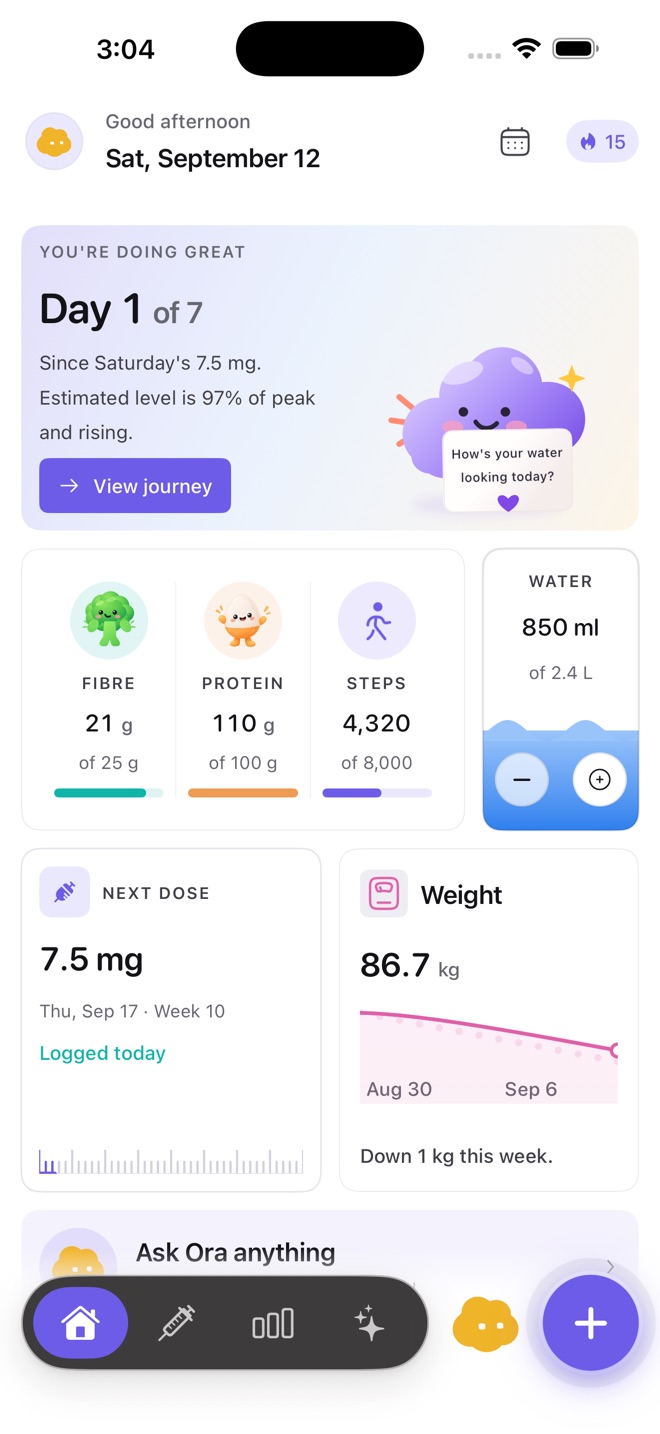
Screens from Cafeity on iPhone.

Common questions
Does Cafeity remind me to wait before breakfast?
Is the tablet the same medicine as the injection?
Can I record both a tablet and an injection?
Sources
- Semaglutide injection and tablets for weight management — US prescribing information DailyMed, US National Library of Medicine, version published 30 June 2026
- Semaglutide tablets for type 2 diabetes — US prescribing information DailyMed, US National Library of Medicine, version published 19 August 2026
Written by the Cafeity team from the sources listed here. Figures from prescribing information are quoted as the label states them; trial results are averages from those trials, not predictions for any one person. This page has not yet been reviewed by a clinician — see the editorial policy for how pages are researched and corrected.