

What the label says
The semaglutide prescribing information gives three numbers that answer most questions:12
The same half-life applies to the injection and to the semaglutide tablets. The tablets are taken daily and absorbed differently, but once semaglutide is in the blood it is cleared at the same rate — the label's 5-to-7-week figure covers the last injectable dose or the last 25 mg tablet.1
Day by day after the last dose
With a half-life of about a week, the arithmetic is simple: every seven days, the level halves. That is an estimate from a population average — the label reports a mean, and individuals clear the drug a little faster or slower — but it describes the shape well.
| Days after the last dose | Remaining (estimate) |
|---|---|
| 1 | 91% |
| 2 | 82% |
| 3 | 74% |
| 5 | 61% |
| 7 | 50% |
| 10 | 37% |
| 14 | 25% |
| 21 | 13% |
| 28 | 6.3% |
| 35 | 3.1% |
| 42 | 1.6% |
| 49 | 0.8% |
"Five half-lives" is the usual shorthand for "essentially gone": after five, about 3% remains; the label's 5-to-7-week window is that rule of thumb in practice.
After a single injection
After a first or only injection, semaglutide peaks 1 to 3 days later and then declines on the same one-week half-life.1 A week after a single dose, roughly half of the peak is left; after five weeks, very little. With regular weekly doses the level builds for 4 to 5 weeks, because each dose arrives while about half of the previous one is still there; after that it rises and falls within a steady band.2
That build-up is why the first month is not a fair guide to how the medicine will feel later, and why a dose increase takes weeks to show its full effect.
When the long half-life matters
- Planning a pregnancy. Because of the potential for harm to a developing baby, the label advises stopping semaglutide at least 2 months before a planned pregnancy, specifically to allow for the long half-life.1 Contraception and pregnancy are covered in GLP-1 medicines, contraception and pregnancy.
- Surgery and sedation. Semaglutide delays stomach emptying, and there have been rare reports of food being inhaled into the lungs during anaesthesia. The label tells patients to inform their healthcare providers before any planned surgery or procedure.1 Whether and when to pause is for the surgical team to decide.
- Side effects after stopping. Because the level falls gradually, so do its effects on appetite and the gut — they fade over weeks rather than stopping overnight.
- A late or missed dose. With half the previous dose still present after a week, one late dose changes the level gradually rather than abruptly. What to do about a missed dose is set out in your medicine's own instructions and is a question for your pharmacist or prescriber.
Why this is an estimate
The half-life on the label is an average from studies of many people. The US label reports no clinically significant differences in semaglutide levels by age, sex, race, ethnicity or body weight, but every individual still clears a medicine at their own rate.1 No home test measures semaglutide, and nothing on this page should be used to time a dose. It is here to explain the shape of the week and the weeks after stopping.
Keeping a record of it
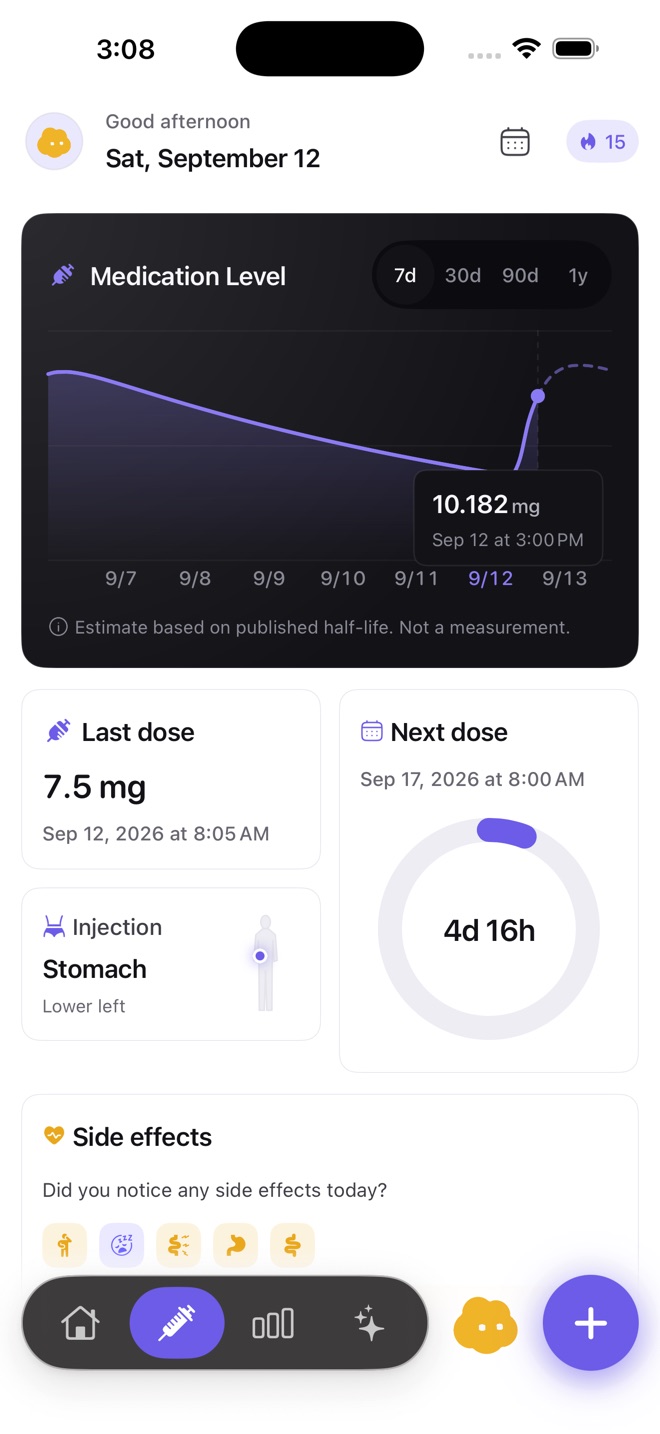
Cafeity's Cycle View uses exactly this arithmetic: it takes the dose dates you log, applies semaglutide's published half-life, and draws an estimated level across the week — labelled on screen as an estimate, not a measurement. Symptoms and appetite can then be read against it.

Common questions
How long does semaglutide stay in your system after stopping?
What is the half-life of semaglutide?
How long does one semaglutide injection last?
Does oral semaglutide leave the body faster?
Sources
- Semaglutide injection and tablets for weight management — US prescribing information DailyMed, US National Library of Medicine, version published 30 June 2026
- Semaglutide injection for type 2 diabetes — US prescribing information DailyMed, US National Library of Medicine, version published 10 June 2026
Written by the Cafeity team from the sources listed here. Figures from prescribing information are quoted as the label states them; trial results are averages from those trials, not predictions for any one person. This page has not yet been reviewed by a clinician — see the editorial policy for how pages are researched and corrected.