

What the label says
Source: the tirzepatide prescribing information, clinical pharmacology section.12
Unlike semaglutide's label, tirzepatide's does not give a "present for N weeks" figure. The five-half-life rule of thumb puts it at roughly 25 to 30 days — a little under a month — after the last dose.
Day by day after the last dose
Using the label range of 5 to 6 days, and 5 days for the central estimate:
| Days after the last dose | Remaining (estimate) | Range (t½ 5–6 days) |
|---|---|---|
| 1 | 87% | 89% – 87% |
| 2 | 76% | 79% – 76% |
| 3 | 66% | 71% – 66% |
| 5 | 50% | 56% – 50% |
| 7 | 38% | 45% – 38% |
| 10 | 25% | 31% – 25% |
| 14 | 14% | 20% – 14% |
| 21 | 5.4% | 8.8% – 5.4% |
| 28 | 2.1% | 3.9% – 2.1% |
| 35 | 0.8% | 1.8% – 0.8% |
| 42 | 0.3% | 0.8% – 0.3% |
| 49 | 0.1% | 0.3% – 0.1% |
The shorter half-life compared with semaglutide means a larger swing within each week: on regular weekly doses, the level just before the next injection is around 38% of the peak, against about 50% for semaglutide. Some people notice that as appetite returning in the last day or two before their next dose.
When the half-life matters
- Oral contraceptives. Tirzepatide delays stomach emptying, which can affect the absorption of medicines taken by mouth. Its patient information says people using birth control pills may be advised to switch to, or add, a non-oral method for 4 weeks after starting and for 4 weeks after each dose increase.1 See contraception and pregnancy.
- Pregnancy. The label advises stopping tirzepatide when a pregnancy is recognised, and asks patients to tell their healthcare provider if they intend to become pregnant.1
- Surgery and sedation. Tell every healthcare provider you take tirzepatide before surgery or any procedure involving anaesthesia or deep sedation; the label notes the risk of food entering the lungs.1
- After stopping. Most of the medicine is gone within about a month, and its effects on appetite and the gut fade over that time.
Why this is an estimate
The half-life is a population average; the label reports a variation of about 20% in clearance between people.1 It does not change meaningfully with sex, body weight, kidney or liver function, according to the label. There is no home test for tirzepatide, and none of this should be used to time a dose — that is for your prescriber and your medicine's own instructions.
Keeping a record of it
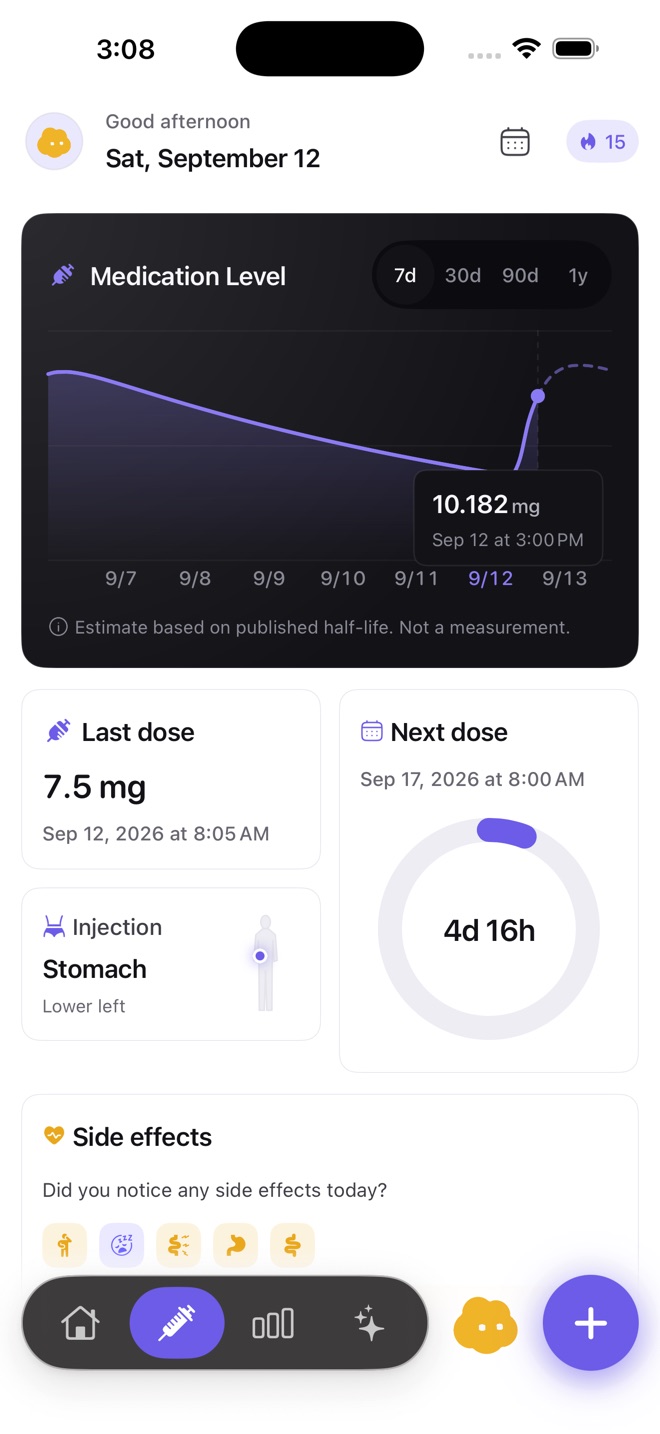
Cafeity's Cycle View applies tirzepatide's published half-life to the dose dates you log and draws an estimated level across the week, labelled as an estimate. Log appetite or food noise alongside it and a late-week pattern, if you have one, becomes visible.

Common questions
How long does tirzepatide stay in your system after stopping?
What is the half-life of tirzepatide?
How long after a tirzepatide injection is the level highest?
Sources
- Tirzepatide injection for weight management and obstructive sleep apnoea — US prescribing information DailyMed, US National Library of Medicine, version published 2 September 2026
- Tirzepatide injection for type 2 diabetes — US prescribing information DailyMed, US National Library of Medicine, version published 2 September 2026
- Semaglutide injection and tablets for weight management — US prescribing information DailyMed, US National Library of Medicine, version published 30 June 2026
Written by the Cafeity team from the sources listed here. Figures from prescribing information are quoted as the label states them; trial results are averages from those trials, not predictions for any one person. This page has not yet been reviewed by a clinician — see the editorial policy for how pages are researched and corrected.