

At a glance
| Value | |
|---|---|
| Form | Once-daily tablet, swallowed whole, with or without food |
| Published half-life | About 29 to 49 hours |
| Time to peak | 4 to 8 hours after a tablet |
| Settles | Within about a week of daily tablets (five half-lives at the mid-range figure) |
| Used in Cafeity for | The decay constant behind the modelled level, and nothing else |
Source: orforglipron prescribing information.1 Nothing on this page is dosing information.
What orforglipron is, in one paragraph
Orforglipron is a GLP-1 receptor agonist taken by mouth once a day. The other medicines in the class are peptides — semaglutide's molecular weight is about 4,100 — whereas orforglipron is a small molecule of about 900.12 It is also taken differently: its label allows it with or without food, whereas semaglutide tablets must be taken on an empty stomach. For everything that belongs on a label — who it is for, who should not take it, interactions, what to watch for — the prescribing information and your prescriber are the right sources.
What a daily tablet changes about tracking
With a weekly injection, the useful question is often "which day of the week was it?". With a daily tablet the level is much flatter, so day-of-week patterns are less likely and other things matter more: the time you took it, whether a tablet was missed, and — for the first weeks and after each change — the fact that the level is still building.
Two label facts are worth having in the record. Oral contraceptives may be less effective: the label advises switching to a non-oral method or adding a barrier method for 30 days after starting and for 30 days after each dose increase.1 And orforglipron interacts with some other medicines through a liver enzyme, so your prescriber and pharmacist need your full medicine list.1
Side effects in the trials
| Reaction | Placebo | 5.5 mg | 9 mg | 17.2 mg |
|---|---|---|---|---|
| Nausea | 10% | 26% | 34% | 35% |
| Constipation | 9% | 20% | 27% | 24% |
| Diarrhoea | 11% | 21% | 23% | 25% |
| Vomiting | 4% | 13% | 21% | 24% |
| Indigestion | 4% | 12% | 16% | 13% |
The label says nausea, vomiting and diarrhoea were more common during the dose-escalation period and decreased over time.1 See GLP-1 side effects for the full picture.
What the record holds
- Each tablet — date, time and the amount you were prescribed.
- Meals, by photo, search or barcode, with protein, fibre and water.
- Symptoms, including nausea, appetite and food noise, with your own severity rating.
- Weight as a smoothed trend, not a daily verdict.
Where your data lives
On your device and in your own account, under per-record permissions. Health data is never stored in iCloud, never sold, never used for advertising, and never used as training data. You can export everything in one file, and you can delete the record entirely. The Visit Summary builds a one-page PDF only when you ask it to, and nothing leaves the phone until you share it yourself.
What Cafeity will never do
- Recommend, calculate or adjust a dose, or tell you when to take one.
- Interpret a symptom, name a condition, or suggest what is causing something.
- Predict how much weight you will lose, or when.
- Set a calorie target below 1,200 kcal, or a weight goal below a BMI of 18.5.
Cafeity is a general wellness product. It does not diagnose, treat, cure, mitigate or prevent any disease or condition. Questions about your treatment belong with a licensed healthcare professional.
Keeping a record of it
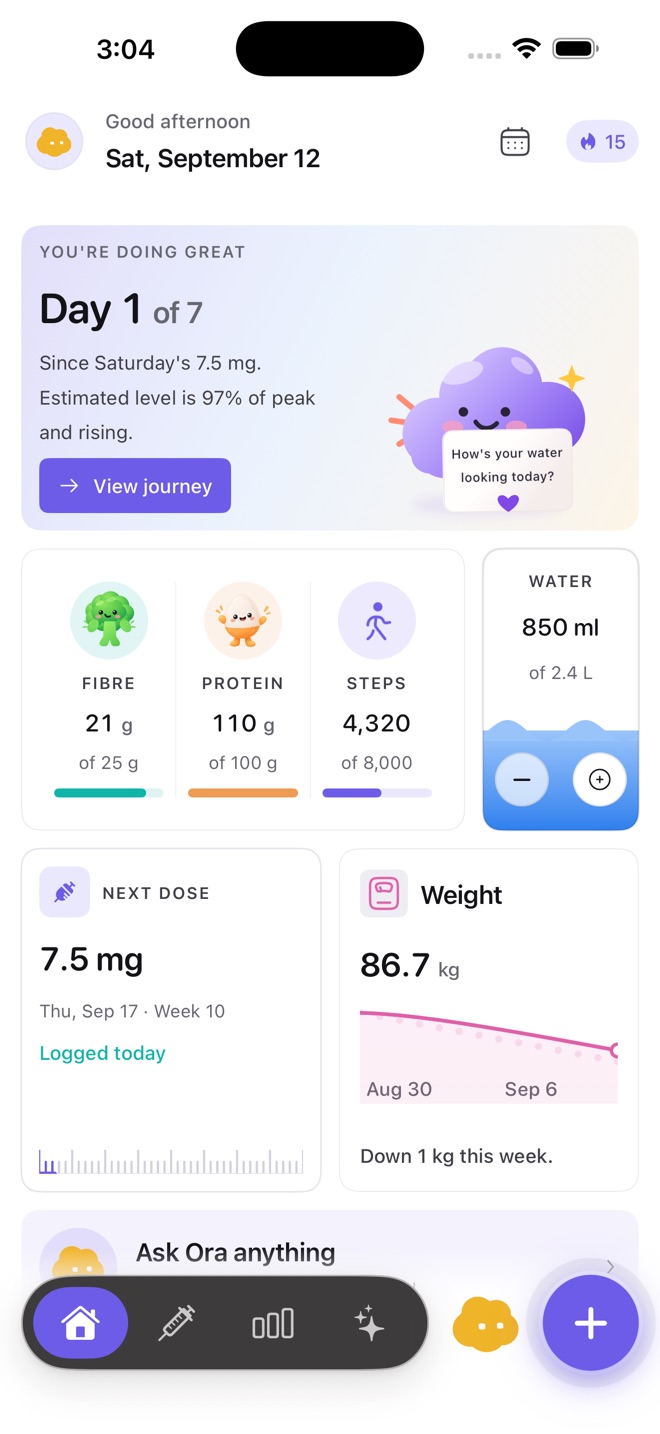
Screens from Cafeity on iPhone.

Common questions
Does Cafeity tell me when to take orforglipron?
Can I take orforglipron with food?
How long does orforglipron stay in the body?
Sources
- Orforglipron tablets for weight management — US prescribing information DailyMed, US National Library of Medicine, version published 13 August 2026
- Semaglutide injection and tablets for weight management — US prescribing information DailyMed, US National Library of Medicine, version published 30 June 2026
Written by the Cafeity team from the sources listed here. Figures from prescribing information are quoted as the label states them; trial results are averages from those trials, not predictions for any one person. This page has not yet been reviewed by a clinician — see the editorial policy for how pages are researched and corrected.