

What the trials show after stopping
In the STEP 1 trial extension, 327 adults stopped semaglutide — and the trial's lifestyle programme — after 68 weeks, having lost an average of 17.3% of their body weight. A year later they had regained two-thirds of what they lost, and most of the improvements in heart and metabolic risk factors had drifted back towards where they started.3
In SURMOUNT-4, everyone took tirzepatide for 36 weeks and then was randomised to continue or switch to placebo. Those switched to placebo regained 14% of their body weight over the following year, while those who continued lost a further 5.5%.4
The 2025 joint advisory sums it up: when GLP-1 medicines are stopped, regain is common, typically nearly to baseline within one year, even with conventional nutrition counselling or behavioural therapy — and more intensive, structured programmes to prevent it have not yet been studied.1 That is worth knowing before anyone promises you otherwise.
Plan stopping with your prescriber
- Agree the reason and the plan: when to stop, and what follow-up you will have afterwards.
- Ask what to watch: your weight trend, and any blood pressure, blood sugar or other measures that improved on treatment.
- Agree a review point — a change in weight or health that would prompt a conversation about what next.
- If you are planning a pregnancy, the semaglutide label advises stopping at least 2 months beforehand; see contraception and pregnancy.5
For what happens to appetite and weight in more detail, see stopping a GLP-1.
Habits linked with keeping weight off
The evidence here comes from people who kept weight off in other settings — most of it from before these medicines existed — so it shows what successful maintainers do, not what is proven to work after a GLP-1. The National Weight Control Registry, for example, follows people who lost an average of 33 kg and kept it off for more than five years.2
| Habit | What the research says | One way to keep it |
|---|---|---|
| Daily activity | Registry members report about an hour of physical activity a day; the joint advisory lists 60+ minutes a day among behaviours associated with long-term maintenance.21 | Walk at the same time every day; see walking more |
| Self-monitoring | Self-monitoring of body weight, food intake and activity is on the advisory's list; registry members self-monitor their weight.12 | Weigh at the same time each week and watch the trend |
| Regular meals | Registry members eat breakfast regularly and keep a consistent eating pattern on weekdays and weekends.2 | Keep the meal times you built on treatment |
| Less screen time | The advisory lists limiting screen time to under 10 hours a week.1 | Swap one evening of screens for a walk or a class |
| Coping strategies | Social support, advance planning and problem-solving skills are on the advisory's list.1 | Plan the hard situations — holidays, stress, travel — before they arrive |
| Strength and protein | The advisory recommends strength training and adequate protein to preserve muscle and bone.1 | Keep the strength week going |
One encouraging finding from the registry: maintenance seemed to get easier with time, and people who had kept weight off for 2 to 5 years had a much better chance of continuing to.2
When appetite and food noise come back
Appetite and food noise often return as the medicine leaves your system over the following weeks. Expect it rather than treating it as a failure. Structure helps: regular meals with protein first, fibre-rich foods, and a plan for the times of day you are hungriest. If food noise is loud, write down when and where it shows up; see food noise and the journal prompts.
Support and follow-up
The joint advisory points to supportive approaches such as group-based visits, counselling with a registered dietitian nutritionist, and telehealth and digital programmes.1 Ask your prescriber what is available to you. And if you restart treatment later, ask how: the labels have rules for restarting after missed doses — the semaglutide label, for example, says that after two or more missed doses in a row, treatment is restarted at a lower dose to reduce the risk of stomach side effects.5
Keeping a record of it
Keep logging after you stop. Cafeity's weight trend shows direction rather than daily noise, and nothing you have recorded is deleted if your plan changes — your treatment history stays with you for the next conversation with your prescriber.

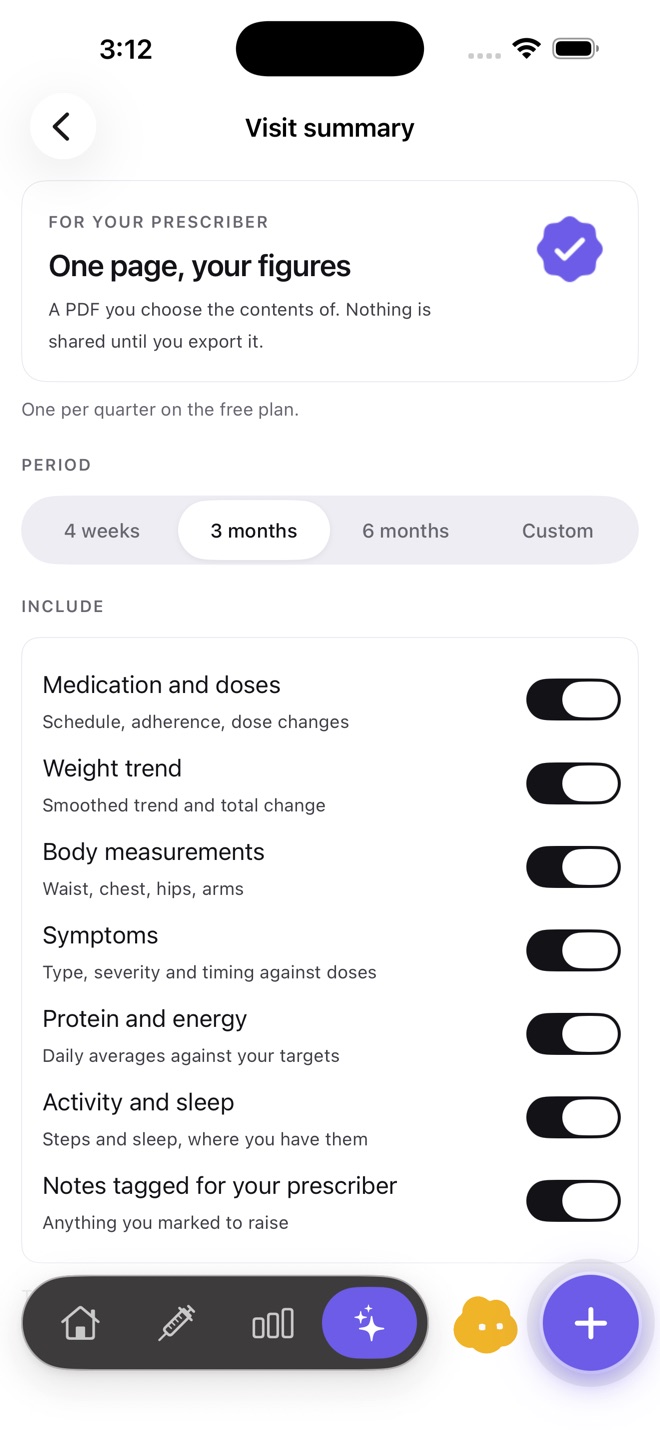
Screenshots: Cafeity for iPhone, version 1.1.
Common questions
Will I regain weight after stopping a GLP-1?
Can habits prevent weight regain after a GLP-1?
What habits help keep weight off?
Should I keep strength training after stopping?
Can I restart a GLP-1 after stopping?
Sources
- Nutritional priorities to support GLP-1 therapy for obesity: a joint advisory from the American College of Lifestyle Medicine, the American Society for Nutrition, the Obesity Medicine Association and The Obesity Society Mozaffarian D et al. 2025 (published in four journals)
- Long-term weight loss maintenance (findings from the National Weight Control Registry) Wing RR, Phelan S. American Journal of Clinical Nutrition 2005;82(1 Suppl):222S–225S
- Weight regain and cardiometabolic effects after withdrawal of semaglutide: the STEP 1 trial extension Wilding JPH et al. Diabetes, Obesity and Metabolism 2022;24:1553–1564
- Continued treatment with tirzepatide for maintenance of weight reduction in adults with obesity (SURMOUNT-4) Aronne LJ et al. JAMA 2024;331(1):38–48
- Semaglutide injection and tablets for weight management — US prescribing information DailyMed, US National Library of Medicine, version published 30 June 2026
Written by the Cafeity team from the sources listed here. Figures from prescribing information are quoted as the label states them; trial results are averages from those trials, not predictions for any one person. This page has not yet been reviewed by a clinician — see the editorial policy for how pages are researched and corrected.